Showing posts with label foreign aid. Show all posts

07 November 2007

How To Make Ultra Poverty History

The World's Most Deprived [IFPRI]"If concentrated in a single nation, the world's poorest people—the ultra poor—would comprise the world's seventh most populous country."

Until now, analysis of global poverty has tended to focus on the almost one billion people who live on less than a dollar a day. A new report by the International Food Policy Research Institute (IFPRI) breaks this group down into those who live on between 75 cents and $1 a day, those who live on 50 to 75 cents a day, and the "ultra poor" who live on less than 50 cents a day. It finds that 162 million people are ultra poor and that, although economic growth is the factor that has had the greatest impact on poverty, for instance in countries such as China and India, the very poorest people benefit the least from reductions in poverty and typically need specific action to be taken to enable them to participate in growth. "The World's Most Deprived: Characteristics and Causes of Extreme Poverty and Hunger" concludes:

Looking at the characteristics of the poorest, we found that the poorest are those from excluded groups, those living in rural remote areas with little education, those with few assets, and—in Asia—those without land.

The analysis suggests that interventions to insure the poor against health shocks, address the exclusion of certain groups, prevent child malnutrition, and enable investment in education and other capital for those with few assets are essential to help the poorest move out of poverty.
Once again, in the reference to those "with few assets" and "without land," we see the wisdom of Old Testament economics, where every family was guaranteed shared access to and use of the land and its natural resources. To the extent that Israel served as a model of God's original economic purposes in creation, we are surely justified in asking how these family-oriented economic principles should be applied in the wider world of modern-day secular society. How, for instance, might enforceable property rights be ensured for those who have been trapped in the downward spiral of debt, poverty, dispossession, and bondage?

Around the world, governments regularly assert ownership of land that local communities believe was theirs and collude with powerful interests to seize land and resources from the poor. Examples that come to mind include: Tajikistan, where I recall whole neighbourhoods being given just weeks to find somewhere else to live in order to make way for a new presidential development in the capital; Chile, where the government sold the Araucaria forests of the Pehuenche people to logging companies; and Laos, where some 6,200 villagers are to be displaced by the Nam Theun 2 dam project, financed by the World Bank and Asian Development Bank, and resettled on insufficient land. To see what happens when property rights are not guaranteed, one only needs to look at what Robert Mugabe has done to the former "bread basket of Africa", Zimbabwe.

As the Peruvian economist Hernando de Soto (author of The Other Path: The economic answer to terrorism) has noted, "They have houses but not titles; crops but not deeds; businesses but not statutes of incorporation." Without clear title to their land, houses, and businesses, the poor cannot sell their assets or borrow against them and lack incentive to invest in that which could be taken from them at any moment; and thus they remain poor. De Soto has calculated the amount of "dead capital" in untitled assets held by the world's poor to be "at least $9.3 trillion" — a sum that dwarfs the amount of foreign aid given to the developing world since 1945.

Those who maintain religion has no place in politics and the Bible (whose vision for society they have probably never sought to read, let alone understand) has no relevance to the many social challenges facing the world might care to reflect that the answers might have been staring us in the face all along ... or rather have been sitting on the bookshelf, just waiting for us to rediscover them.

25 September 2007

So Much For Good Intentions

BBC: In pictures: Protesters defy juntaDavid Miliband may have learnt that it's not good enough to have good intentions, but neither is it good enough for the foreign secretary to appear completely unbriefed about one of the hottest international issues of the day — namely, the protests in Burma. His inability to provide a satisfactory answer to any of Jeremy Paxman's questions about British investment in Burma [the world's second highest] or commitment to pro-democracy movements there [none] on Newsnight was appalling.

Our government should be following President Bush's lead, who today announced a tightening of sanctions against the Burmese junta:

"The United States will tighten economic sanctions on the leaders of the regime and their financial backers. We will impose an expanded visa ban on those responsible for the most egregious violations of human rights, as well as their family members. We will continue to support the efforts of humanitarian groups working to alleviate suffering in Burma, and I urge the United Nations and all nations to use their diplomatic and economic leverage to help the Burmese people reclaim their freedom."

03 September 2007

Last Week Changed The World

Imagine that the BNP were to kidnap a group of Pakistani Muslims, hold them to ransom, and negotiate directly with the government of Pakistan, who only secure their release on condition that all Pakistani Muslims working in the UK leave immediately and no Muslim from Pakistan be allowed to return in future.

Unthinkably preposterous as this sounds, that is comparable to what the Taleban have achieved in Afghanistan. Despite being an insurgent group (or, at best, a non-state actor), they were able to engage directly a modern state in negotiations. As a reward for their lawlessness, they have secured the withdrawal of all Christian workers and the promise that no other Christian workers will return in future from an entire country, South Korea. Never before has the removal of Christian missionaries from a location been permitted as a negotiable condition in any previous hostage case.

As a consequence of this precedent, we can surely expect to see further kidnappings of Christian workers (whether missionaries or relief workers) with attendant demands that Christian workers leave nations that the hostage-takers do not control. Not only in Afghanistan, but in any location where there is a clash of Christian and Muslim evangelism or where both Christian agencies (or, indeed, any international aid agencies from what are perceived to be "Christian" countries) and Muslim extremists operate, Islamist terrorists and insurgents wanting to elevate their own political status will take note of South Korea's concession.

The world of humanitarian relief and development just became significantly more problematic. It is the South Korean government, not the surviving South Korean aid workers, who should be apologising for the trouble they have caused.Former hostage Yu Kyeong-sik apologising to South Korea for causing trouble by going to Afghanistan [BBC]

24 July 2007

In It Together

Globalisation and Global Poverty

Poverty is a denial of human potential. The stifling of dynamism, creativity and intelligence that attend poverty affects us all. Unleash that potential and we will all benefit through an explosion of thought, culture and trade.

In the twenty-first century extreme poverty is not only a preventable economic absurdity but a moral disgrace. That is what has motivated this group in its work.

But even if we were driven purely on the basis of self interest then act we must. Poverty undermines our security and prosperity as well as our humanity. It is necessary for our own well-being that we work together to remove the scourge of poverty that so blights our time.

The bald fact is that extreme poverty does not affect only the few, it harms the many. We are all in this, like it or not, together. And that is the only way that poverty will finally be eradicated: together.
So begins Peter Lilley in his introduction to the second of the Conservative Party's policy group reports, published today. Unlike the Social Justice Policy Group's recent report, media coverage of In it together: the attack on global poverty, from the Globalisation and Global Poverty Policy Group, has so far been very poor.

Overall, with its emphasis on trade and training instead of aid and tariffs, it looks good, although expecting the World Bank and other multilateral organisations to track corruption seems rather naive. In all, the group makes 76 recommendations, all of which could be funded within the current commitment to spend 0.7% of national income on international aid. Here are a few of the highlights, listed under the report's six headings:

Aid
  • DFID’s process for allocating bilateral aid should be adjusted from a cliff edge to a slide. So when low income countries pass the middle income threshold they should no longer risk losing all their aid.
  • DFID should continue to develop funding mechanisms which provide longer term, more stable and more flexible aid funding. This principle should apply both to bilateral aid and that provided through NGOs and local partners.
  • We recommend that DFID should allocate its aid budget so as to encourage NGOs to develop specialist competences and focus on them, and should be more willing to use smaller NGOs which have already specialised in a particular function or country and proven their ability and integrity.
  • DFID should create a Human Rights Review Panel to advise whether aid should continue to flow to governments after human rights abuses occur and DFID should respond speedily but proportionately to any deterioration in standards, thereby obviating the need for a more drastic response later on.
  • The UK must make a long-term commitment to training medical staff in countries with the greatest need for them.
Economic development
  • Increased UK support for skills and enterprise training for young people is necessary.
  • The UK should endeavour to extend its support for secondary education, to assist low income countries in moving towards universal secondary education.
  • We support the provision of development funding directly to private sector enterprises and entrepreneurs, if this offers the best way to tackle poverty.
Trade
  • There is a strong case for allowing low income countries, in particular, i) open access to EU and other developed country markets; and ii) flexibility as to how rapidly they liberalise their domestic markets. Real Trade involves both.
  • The UK should aim to spend a larger proportion of its existing aid budget to 2013 on aid for trade.
  • The UK should press the EU to take up the US offer of an end to all market distorting support as part of the Doha Round. At the very least the UK should press for the EU to meet the G20’s request for deeper reductions. The UK should also seek to hold the EC to its earlier offer to abolish all subsidies on exports from the EU ... The UK should push for an immediate end to certain CAP programmes such as tobacco and cotton subsidies.
Corruption and governance
  • DFID should live up to its promises and respond more vocally, robustly and proportionately to evidence of corruption affecting UK aid.
  • Aid to promote good governance should be used to help both stimulate and satisfy demand for greater accountability, by strengthening the capacity of civil society to challenge governments over issues of corruption, human rights, and transparency and accountability.
Conflict, fragile states and humanitarian aid
  • The UK should support an International Arms Trade Treaty to curb the flow of weapons to conflicts.
  • Pledges for quick-onset emergencies should either be made from existing contingency funds or from new money, and should not involve the re-allocation of previously allocated funds.
  • What is needed is greater coordination, not centralisation. If donors duplicate, this is a waste, but if the UN were to attempt to centralise all donors and then assign tasks this could take up valuable time – putting lives at risk. Attempts to centralise responsibility under a single agency should be resisted by the UK Government.
  • The UK should welcome and undertake to uphold the commitment of the international community at the UN Millennium Review Summit in 2005 to ‘take collective action [to protect vulnerable populations] in a timely and decisive manner . . . should peaceful means be inadequate and national authorities [be] manifestly failing to protect their populations from genocide, war crimes, ethnic cleansing, and crimes against humanity’.
DFID - the aid effectiveness challenge
  • DFID should, as a leading bilateral donor, take a much more robust line with multilaterals, demand evidence of effectiveness and performance, be ready to withhold discretionary funding where necessary and through this more assertive stance create real impetus for change.
  • DFID must focus on results, rather than processes, and must develop methodologies and techniques that will enable a results-focused comparison of different projects and programmes.
  • Our proposed option for the evaluation of DFID’s effectiveness is the creation of an Independent Evaluation Group which would report to Parliament via the International Development Select Committee.

02 July 2007

World Poverty - Who Cares?

"Existing trade barriers, agricultural subsidies and restrictive rules on intellectual property rights reinforce global inequities – and they make a mockery of our tall claims to eliminate hunger and poverty from our world."

The United Nations' mid-point progress report on the Millennium Development Goals (MDGs), published today, notes that although extreme poverty is beginning to fall in sub-Saharan Africa and the poorest are getting a little less poor in most regions of the world, poverty reduction has been accompanied by rising inequality and half the developing world remains without basic sanitation.

The report claims that the MDGs are still attainable and affirms that "The world wants no new promises." However, if success is to be achieved in the poorest and most disadvantaged countries, "Developed countries need to deliver fully on longstanding commitments to achieve the official development assistance (ODA) target of 0.7 per cent of gross national income (GNI) by 2015." In particular, it notes, the Group of 8 industrialised nations need "to live up to their 2005 pledge to double aid to Africa by 2010 and European Union Member States to allocate 0.7 per cent of GNI to ODA by 2015."

Speaking at today's meeting of the UN Economic and Social Council (ECOSOC) in Geneva, UN Secretary General Ban Ki-moon told the heads of the United Nations and the World Trade Organisation, "The world desperately needs a successful conclusion to the Doha trade negotiations." However, any realistic chances of a deal have already been dashed with the collapse of talks last month between the so-called "G4" group of the World Trade Organisation's four most powerful members—that is, the European Union, United States, Brazil, and India.Understanding of Poverty: What does it mean to be poor? [Credit: USAID]

08 June 2007

Bush Leads G8 AIDS Deal

President George W. Bush holds Baron Mosima Loyiso Tantoh in the Rose Garden of the White House after delivering a statement on PEPFAR, the President's Emergency Plan for AIDS Relief. Baron's mother, Kunene Tantoh, represents Mothers to Mothers, an organisation which provides treatment and support services for HIV-positive mothers in South Africa. [Credit: Eric Draper, The White House]Leaders of the G8 nations will today pledge to spend $60bn (£30bn) fighting Aids in Africa. However, before we crack out the champagne, we ought to look at their track record. So far, they have provided less than 10% of the extra aid they promised Africa at the G8 summit in Gleneagles almost two years ago. Doing slightly better than most of our European partners—and much better than the current G8 president, Germany, who has performed particularly badly—Britain's overall aid budget has increased by 12.6% over this period. However, it is America who is leading the way in the global fight against HIV/AIDS. Here's what President Bush had to say last week:

The United States has responded vigorously to this crisis. In 2003, I asked Congress to approve an emergency plan for AIDS relief. Our nation pledged $15 billion over five years for HIV/AIDS prevention, treatment and care in many of the poorest nations on Earth. In the years since, thanks to the support of the United States Congress and the American people, our country has met this pledge. This level of assistance is unprecedented, and the largest commitment by any nation to combat a single disease in human history.

This investment has yielded the best possible return: saved lives. To date, the emergency plan has supported treatment for 1.1 million people infected with HIV. This is a promising start, yet without further action, the legislation that funded this emergency plan is set to expire in 2008. Today I ask Congress to demonstrate America's continuing commitment to fighting the scourge of HIV/AIDS by reauthorizing this legislation now. I ask Congress to double our initial commitment and approve an additional $30 billion for HIV/AIDS prevention, for care, and for treatment over the next five years.
So, when you hear German Chancellor Angela Merkel announce their landmark new AIDS deal, just remember: there would be no deal without President Bush, who will contribute at least half of the pledged assistance—and who is the only one with a record for delivering on his pledges.

31 May 2007

Climate Convert Or Con Artist?

President George W Bush addressing the United States Global Leadership CampaignAmerican President George W Bush has urged countries to agree on long-term goals for greenhouse gas emissions but will oppose demands at next week's G8 summit in Germany for the USA to cut emissions and join a global carbon trading system. Is he belatedly trying to seize the initiative on climate change, or is this simply "a deliberate and carefully crafted attempt to derail any prospect of a climate change agreement," "a delaying tactic to keep the climate change issue off his back in terms of any real decisions until he leaves office," as Tony Juniper, the executive director of Friends of the Earth believes?

Outlining his development strategy "to bring progress and prosperity to struggling nations all across the world" to the United States Global Leadership Campaign, a coalition of more than 400 businesses, humanitarian organisations and community leaders, the President also called on Congress to double US funds for the global fight against HIV/AIDS and to fund his 2005 commitment to expand American assistance to sub-Saharan Africa to $8.67 billion by 2010.

11 May 2007

More Broken Promises

European AidFor the second year in a row, more than 1,800 development NGOs from 27 EU countries have compiled a report showing that European governments are artificially inflating the amount of foreign aid they claim to be donating to poor countries.

At least one third of all European aid is in fact "inflated aid" that does not deliver any fresh resources for poor countries and does not directly reduce poverty. This includes:

  • Nearly €11 billion (£7.5bn) of debt cancellation — €8bn (£5.5bn) of which went exclusively to Iraq and Nigeria
  • €1.6 billion (£1.1bn) spent educating foreign students in Europe, and
  • €1 billion (£700m) spent housing refugees in Europe.
Counting just genuine aid, the European Union spent just 0.30% of its Gross National Income (GNI) on foreign aid in 2006, missing its target of 0.39% by about a quarter. So much for talk of an ethical foreign policy! Western governments, our own included, could begin with a little more honesty and integrity at home, and improve transparency in their aid reporting.

Three years ago, a Foreign Policy Centre report entitled Moral Brittania? Evaluating the Ethical Dimension in Labour's Foreign Policy examined how far reality had matched Robin Cook's famous 1997 promise to formulate "a foreign policy with an ethical dimension." It argued that such a policy need not involve the sacrifice of national interests, warned against "presidential" foreign policymaking, and suggested being a pivotal power may require the UK to distance itself from the US. Not a bad read while the media obsesses with Blair's legacy.

13 April 2007

IMF Hinders African Progress

International Monetary FundAn average of just 30 pence in every pound of foreign aid increases to Sub-Saharan African countries can be spent because the International Monetary Fund requires governments under its supervision to redirect the use of foreign aid increases to either boost international currency reserves or to pay down domestic debt.
This is the shock finding reported by the IMF's Independent Evaluation Office in meetings today and directly undermines Africa's fight against AIDS, illiteracy, and hunger.

Now, the IMF is not an independent body. It is an intergovernmental body. That means the governments responsible for approving an increase in their foreign aid budgets are also the ones responsible for deciding IMF policy. Our charitable leaders are therefore giving with one hand, only to take away with the other ... behind our backs. So much for the exhortation to "Let your giving be in secret" – the Western world's leaders have paraded their giving (and, even more so, their unfulfilled promises of giving) but hidden the fact that they've not been as generous after all.

11 April 2007

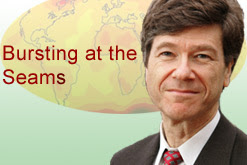
Bursting at the Seams

"Let us not be blind to our differences, but let us also direct attention to our common interests, and the means by which those differences can be resolved. And if we cannot end now our differences, at least we can help make the world safe for diversity, for in the final analysis our most basic common link is that we all inhabit this small planet, we all breathe the same air, we all cherish our children's future, and we are all mortal."

Bursting at the SeamsSo concluded Professor Jeffrey Sachs in the first of this year's Reith lectures this morning, after asking some challenging questions about the geo-political problems facing our generation as a result of living in an unprecedentedly crowded world:

Can it be true that because we don't want to talk to Iran, H5N1 won't pass through Iran, we won't have to deal with avian 'flu in places we don't want to speak to, because we put on pre-conditions to negotiations, that we can't see the commonality of our problems? And can it really be, ladies and gentlemen, that the solution to Darfur, one of the most urgent crises on the planet, is all about peacekeepers and troops and sanctions, when we know that in Western Darfur the rebellion started because this is just about the poorest place on the whole planet, where the rebellion started because there's not enough water to keep people alive, where the livestock have no veterinary care, where there's no basic infrastructure, where a power grid may be a thousand miles away? Can we really think that peacekeeping troops and sanctions will solve this problem?

And how can it be, ladies and gentlemen, that we think we can be safe? We think we can be safe when we leave a billion people to struggle literally for their daily survival, the poorest billion for whom every day is a fight to secure enough nutrients, a fight against the pathogen in the water that can kill them or their child, a fight against a mosquito bite carrying malaria or another killer disease for which there's no medicine though the medicines exist and are low cost but there's no medicine in the village available to save the child and thus a million or two million children will die this year of malaria. How can we think that this can be safe? And how can we choose, as we do in the United States, to have a budget request this year of six hundred and fifty billion dollars for the military - more than all the rest of the world combined - and four and a half billion dollars for all of African assistance, and think that this is prudent? One might say oh it's a science fiction that a zoonotic disease could arise and somehow spread to the world, except that Aids is exactly that. How many examples do we need to understand the linkages, and the common threats, and the recklessness of leaving people to die, recklessness in spirit, in human heart, and in geo-political safety for us?
However, despite Sachs' infectious optimism, like a number of people in the audience, I felt that the kind of "gradual evolution in human institutions" that Sachs is calling for if mankind is to rise to these great global challenges requires too much faith in intergovernmental institutions and a step change in human nature which is simply not going to happen.  Any thoughts anyone?

04 April 2007

Africa Hypocrisy

Live8: The Long Walk To Justice2005 was to be a turning point for Africa. Tony Blair launched the Commission for Africa and pledged that the continent would be a priority during the UK's presidencies of the G8 and the EU that year. We were told that security in Europe was dependent on recovery in Africa. G7 finance ministers agreed to cancel 100% of the debts owed to multilateral bodies like the International Monetary Fund. World leaders at Gleneagles assured the millions of Live8 and Make Poverty History protesters that they would double aid to Africa by 2010.

Today we learn how long the empty rhetoric promised commitment lasted – aid to sub-Saharan Africa, excluding debt relief for Nigeria, increased by just 2% last year and overall aid payments to the developing world fell by more than 5%.