Photo of the Day

including Faye Turney.
 2005 was to be a turning point for Africa. Tony Blair launched the Commission for Africa and pledged that the continent would be a priority during the UK's presidencies of the G8 and the EU that year. We were told that security in Europe was dependent on recovery in Africa. G7 finance ministers agreed to cancel 100% of the debts owed to multilateral bodies like the International Monetary Fund. World leaders at Gleneagles assured the millions of Live8 and Make Poverty History protesters that they would double aid to Africa by 2010.
Today we learn how long the empty rhetoric promised commitment lasted – aid to sub-Saharan Africa, excluding debt relief for Nigeria, increased by just 2% last year and overall aid payments to the developing world fell by more than 5%.
 John Humphrys noted this morning that having children is not a right. Given that:
As the Iran hostage drama drags on, life continues much as normal for the Iranian population. For two women who were collecting signatures in support of a petition to reform Iranian laws that discriminate against women, this has meant their arrest. Charged with "actions against national security," the two women are members of the One Million Signatures Campaign which aims to educate women in Iran about their legal rights and promote reform of discriminatory laws. This follows the arrest ahead of last month's international women's day of more than 30 women protesters, who were subsequently released.
As we look at the state of the country today, it is worth recalling that a century ago Iran made real advances towards the emancipation of women. In 1906, seven years before our Emily Davison was killed during the Derby after she ran out in front of the King's horse, Iran's Mrs Jahangeer threw herself in front of the Shah's carriage demanding gender equality and warning him to adopt the proposed constitution. In January 1953, the democratically elected government of Mohammad Mossadegh, soon to be overthrown in a joint British-CIA coup, proposed in Parliament to give women the vote, and Iranian women won legal rights before the Revolution that are still rare across the rest of the Muslim world today.
So, if you join the free the navy 15 protest Wednesday evening, spare a thought for the citizens of Iran, who may be mobilised to protest against us Brits*, but are not free to protest about other matters that might in fact be closer to their hearts.
* I often remember a story John Simpson tells of how he walked through a rabid crowd of Iranians chanting "Death to America! Death to Britain!" only to be stopped and asked where he was from. When he hesitatingly responded that he was British, he says the man's visage was transformed to one of friendship as he welcomed John to their country, before turning back to the protest with more chants of "Death to Britain!" That anecdote captures the spirit of Iran perfectly :-)
"The fair trade movement claims that the products it provides are sourced “justly” and that purchasing fair trade products brings economic benefits for the poor. Whilst it is clear that fair trade might bring some benefits to particular groups, whether it brings significant net benefits to the poor in general is questionable. Moreover, the claim that fair trade transactions are more “just” cannot be substantiated. Customers also might be surprised to learn that the majority of the Fairtrade Foundation’s income is spent on promoting its own brand."So begin Philip Booth and Linda Whetstone in the new Institute of Economic Affairs Current Controversies Paper Half a Cheer for Fair Trade. They conclude: "Fair trade may be fashionable and give people a nice warm feeling but only free trade backed up by the rule of law and the protection of private property have actually lifted entire populations out of poverty for the long term." As I said last week, it seems buying the right coffee is no longer sufficient.
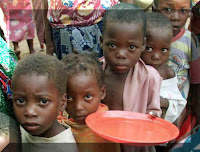 Twenty suspected HIV-positive children of failed asylum seekers are due to be deported, according to Martin Narey, the chief executive of the leading children's charity Barnardo’s.
While Mr Narey claims deporting the children would be to send them to their deaths, the Home Office says that "We are not convinced that a special dispensation should be made for victims of HIV. It could create inconsistencies in how we treat people with other serious illnesses."
Do readers think compassion should outweigh other criteria used to determine such cases, or would it merely risk opening the floodgates for others who are sick to attempt to gain entry to this country and, once here, to be supported by our tax-payer-funded health service?
The leader of Zimbabwe's opposition Movement for Democratic Change, Morgan Tsvangirai, says President Robert Mugabe should get immunity from prosecution in order to encourage him to step down.
Despite his repeated arrests and recent mistreatment, the opposition leader says "Retribution is no solution," adding that no amount of retribution would compensate for the costs and the pain of Mugabe's rule.
However, this is not the first time such an offer has been extended, so there is no reason to suppose the ruling Zanu-PF party is ready to abandon the dictator just yet, especially since they have only just given their backing for Mugabe to run as their candidate in the 2008 presidential elections.
 The shelves of Waterstones in London display a distinct paucity of books exploring the interconnection of faith and politics. Even with a wider search of books on a political and moral values debate, they are still thin on the ground. However, just a cursory glance at the vast shelves of books on politics in any branch of Borders in America reveals the fascination, or at least the sincere engagement, of the faithful with politics. Whether from a predictable right-wing commentator such as Ann Coulter or the manifesto-like declarations of Barack Obama, there is no shortage of narrative.
Outside of either category lies Our Endangered Values by former president Jimmy Carter, a man whose humanitarian work still has an immense effect on people’s lives, and whose faith is an integral part of his decision-making. With chapters on faith and fundamentalism, homosexuality and humanity, peace and proliferation, it reads very much like a creed – a response to issues of the day in the light of faith, with a declaration of belief and associated actions. From the outset, however, the book is a paradox. While on the one hand it holds out a Biblical perspective on the issues Carter faced while in the White House, his own accounts of his actions while president show how he consistently forced his beliefs into submission to the will of the people. Despite all the Biblical window-dressing, the book leaves a lasting impression of a presidency where principle crumbled before popular opinion.
That is not, in any way, to downplay Carter’s considerable achievements from the Oval Office. The delicate diplomatic juggling acts that were no doubt performed in order to maintain leadership amid such pivotal events as the Iranian kidnapping and the case of Roe v Wade are testament to his abilities as a leader. However, his deference to the philosophy of pragmatism at the expense of a commitment to Biblical truth is hard to reconcile with his frequent assertions that his Christian faith was the bedrock of his leadership. The “life” issues are perhaps the topics where Carter most explicitly acknowledges the potential for compromising the tenets of faith, when he states that he “never believed that Jesus Christ would approve either abortions or the death penalty, but I obeyed such Supreme Court decisions to the best of my ability”. This elevation of the majority opinion over conviction of faith arises again when discussing divorce: “with a clear majority of Americans condoning divorce … it may be best to leave the US Constitution alone”.
However, this seeming surrender to popular opinion is countered by wise consideration of the political ramifications of building specific moral duty into the fabric of government, especially when the endgame becomes waiting “for the US Supreme Court to give the ultimate answer”. Should the church not more loudly acknowledge that they do not “regard homosexuality as a significant factor in [the] multitude of failed marriages”? Holding on to absolute values via loud condemnation does not excuse the church of its responsibility to find instruments to demonstrate why it believes Biblical guidelines are good not just for them, but good for everyone, the natural position to be taken when believing in a sovereign God who created the world and everything in it.
Ultimate confusion is introduced when the conclusion of a chapter on human rights refers to “ancient and unchanging moral principles”. It’s at this point the coherence of Carter’s worldview begins to falter. How is it possible to hold human rights as “unchanging” but bow to majority opinion on a Biblical pillar of societal cohesion such as marriage? A decision has been taken that certain truths are absolute and others relative; that some values can and should be built into the fabric of law and leadership, and others not. It was this worldview, and its consequences for the formulation of policy and national leadership, that I was searching for but did not find.
The book is a fascinating glimpse into the thinking of a past leader of a great nation, and does contain important challenges to the wider church. That said, it does not reveal a new or carefully articulated understanding of how to lead a nation by faith. A contribution to the conversation we should all be having? Yes. A foundation on which to work? No.
£17.99
Simon & Schuster Adult Publishing Group
Review by Mike Causey
Saturday's mention of the call for NHS patients to be allowed to top up cancer care in the private sector prompts me to quote from the thought-provoking article by Graeme Leach, chief economist for the Institute of Directors, in the current edition of The Difference magazine:
Just suppose there was a voice from heaven and the Lord commanded that Parliament enact only one more piece of legislation and nothing thereafter. Faced with such a binding absolute constraint, what would you choose? This is the last piece of legislation ever to emerge from the mother of parliaments. What can you do to have the maximum force for good over the coming centuries? Of course there are many options, but from a Biblical and economic perspective the introduction of education vouchers must surely contest for pole position.What do you think? If you could enact just one more piece of legislation, what would you choose?
The introduction of education vouchers could transform the economic and political culture of the UK while at the same time fulfilling the Biblical instruction to parents to take control of the education of their children. At the beginning of the 21st century we have consumer choice in every area of our lives, except the most important, the future of our children.
In the knowledge economy, education and skills are the prime factors of production. Do we really want to spend the 21st century with the number one factor of production in the hands of the state? Imagine a world where education is free at the point of use (with the option to top-up the voucher if you wish to go to more expensive schools) and parents seek out the school that best fits the needs of their child, from a multitude of suppliers meeting a diverse range of academic, vocational, sporting and, yes, spiritual needs.
 Less than two weeks after Parliament passed the new Sexual Orientation Regulations, the conflict between religious beliefs and human rights legislation is to be tested once again this week. The Bishop of Hereford faces claims that he has breached employment practice by unlawfully blocking the application of a homosexual to work in his diocese on grounds of sexual orientation.
The case reopens the controversy facing the Archbishop of Canterbury, who just last week challenged the Anglican Church to become "a safe place for gay and lesbian people to speak about their lives openly."
The charges are being brought by John Reaney, backed by the gay equality organisation Stonewall, who claims he was initially offered a job as a youth worker but was then turned down following a meeting with the bishop in which he was asked "humiliating" personal questions about his private life. A spokesman for the Diocese of Hereford maintains that Mr Reaney "did not get the job he applied for in the diocese. He was not offered the job and therefore an offer cannot have been withdrawn. We expect the same sexual standards of behaviour from support ministers, or lay ministers, as we do of clergy."


