Showing posts with label Iran. Show all posts

05 December 2007

Time For Dialogue

President Mahmoud Ahmadinejad at Iran's nuclear enrichment plant [Credit: Washington Post]This blog has previously argued for taking a more conciliatory approach to Iran (see Conservative Muslims May Be Right and Influencing Iran). In the wake of Monday's revelations from the US National Intelligence Estimate (NIE) that Iran stopped its nuclear weapons program in 2003, The Washington Post is also now suggesting America should open direct talks with Tehran:

Negotiating will appear at first to be a sign of weakness. The Iranians could use talks to exploit fissures between the United States and its allies, and within the U.S. political system.

But there is a good case for negotiations. Many around the world and in the United States have imagined that the obstacle to improved Iranian behavior has been America's unwillingness to talk. This is a myth, but it will hamper American efforts now and for years to come. Eventually, the United States will have to take the plunge, as it has with so many adversaries throughout its history.
Going on, the author Robert Kagan notes, "The United States simultaneously contained the Soviet Union, negotiated with the Soviet Union and pressed for political change in the Soviet Union -- supporting dissidents, communicating directly to the Russian people through radio and other media, and holding the Soviet government to account under such international human rights agreements as the Helsinki Accords. There's no reason the United States cannot talk to Iran while beefing up containment in the region and pressing for change within Iran."

Whether the Bush administration proves to be "smart and creative enough" to adopt such an approach could affect us all.

15 October 2007

Iran Has The Last Word

Reuters: Iran calls on Muslims to boycott peace conferenceIs there not a degree of irony that, while the Archbishop of Canterbury Dr Rowan Williams has now welcomed last week's "Common Word" claims by 138 of the world's top Muslims that Islam is a religion of "peace", Iran's top cleric, the Supreme Leader Ayatollah Ali Khamenei, has urged Muslim countries to boycott a US-sponsored international peace conference on Palestinian statehood next month?

26 September 2007

Conservative Muslims May Be Right

When it comes to issues such as the importance of family and marriage in society, Christians can find that they have more in common with people of other faiths than they do with people of no faith. So, although you may not find me agreeing with Muslims on any points of theology, the Conservative Muslim Forum may well be right in their response to the Globalisation and Global Poverty Policy Group's report An Unquiet World:

"Regardless of the foreign policies of the United States, hostility to Iran is not in Britain's national interest. A constructive engagement with Iran offers many possibilities for progress... Instead of joining the United States in demonising Iran, Britain should assist Iran in addressing these legitimate security concerns in a manner that improves our security rather than weakening it."
In the current issue of The Difference, Christopher Catherwood argues that neither a military strike nor economic sanctions would be likely to provide a solution to the threat posed by Iran:
"To attack Iran would be to unite all Iranians against us, even those who might otherwise be deemed progressive. An attack on Iran would also, the experts claim, be logistically almost impossible to win, as the relevant nuclear material can be hidden in thousands of underground places all over the country, even if the two major installations could successfully be taken out in a large-scale strike.

But if we cannot attack Iran, and the hardliners and even moderates seem to want a nuclear capability, what can the West do? Russia refuses to get involved, as it considers anybody who damages the US or its interests as its friend, however dangerous they might be. Not only that but if Iran’s neighbours, including a majority Shia Iraq, refused to operate sanctions, then no matter how harsh the financial measures the rest of the world might want to impose, they would be unlikely to provide a solution."
So, what options are left? Well, as the GGPPG intimated in An Unquiet World, there is the possibility of applying diplomatic pressure through India which, despite having voted twice against Tehran at the IAEA, maintains a strategic relationship with Iran and "is extending ties to other countries in the region with an equal interest in restraining Iran, including Saudi Arabia. The Saudi kingdom is India’s largest provider of oil and is home to an estimated 1.5 million Indian nationals. As important, it is one of the few Islamic theocracies viewed favourably by the West, which has worked for a demilitarised Kashmir and has supported India’s observership in the Organisation of the Islamic Conference."

As this blog argued earlier in the year, there is also an opportunity for America to undermine the mullahs' theocratic regime and promote democratic reform by lifting economic sanctions. So, to answer the question about whether or not to engage with Iran, I am inclined to agree with the CMF that while we should continue to oppose Iran’s nuclear weapon ambitions, our approach "should be one of negotiation and mutual dialogues, not threats" and "our primary goal should be assisting in the strengthening of Iranian state institutions to avoid any risk of the transfer of nuclear technology to non state actors."

24 September 2007

To Engage Or Not To Engage...

Ahmadinejad waving from the steps of his plane"Would Columbia [University in New York] ever invite a white supremacist, or an evolutionary creationist, or an advocate of the murder of abortion doctors to speak on campus, counting on the power of dialogue to counter offensive and even odious ideas? Clearly it wouldn't."

The IHT argues that it would have been better for Iranian President Mahmoud Ahmadinejad to have been given permission to lay a wreath at Ground Zero to the victims of 9/11† than to be invited to speak at Columbia:

"It would have opened him up to certain questions. Maybe somebody at Columbia will ask them anyway. For example: If you're sorry about the victims of 9/11, what about the victims of the Holocaust, which you deny took place? And, When are you going to lay a wreath to the victims of violence by Hamas and Hezbollah, whom you bankroll, train and arm?"
What do you think?

Apparently this may yet happen anyway, as the visit is still on the leader's itinerary.

27 June 2007

Nuclear Fears Spark Petrol Protests

Petrol stations set ablaze as Iran starts fuel rations [Credit: The Guardian]Last night, after the government gave just two hours notice that private motorists would be rationed to just 100 litres of petrol a month, increasing tensions in Iran over the failure of President Mahmoud Ahmadinejad to deliver on promises of greater prosperity exploded in violence. Drivers attacked petrol stations across the Iranian capital, Tehran, resulting in three people being killed.

Before anyone thinks that protestors chanting "Guns, fireworks, tanks, Ahmadinejad should be killed" means that the hard-line Iranian government is about to be toppled in a "velvet" or "orange revolution," it should be recalled that even threats of "Death to America! Death to Britain!" need to be understood in their cultural context. Moreover, even angry fuel protests in this country in September 2000 (when the price of petrol was a mere 81p per litre) had no apparent effect on the result of the subsequent election and later fuel protests in 2005 had even less of an impact.

Although an oil-rich country, Iran lacks the capacity to refine its crude oil, forcing it to import about 40% of its petrol. The fuel rationing is a measure to restrict its consumption, as the government sells petrol at about a fifth of its real cost but fears possible UN sanctions over its nuclear program.

24 June 2007

Huge Crackdown On Dissent

Iran is in the throes of one of its most ferocious crackdowns on dissent in years, analysts say. with the government focusing on labor leaders, universities, the press, women's rights advocates, a former nuclear negotiator and Iranian-Americans, three of whom have been in prison for more than six weeks.

The shift is occurring against the backdrop of an economy so stressed that although Iran is the world's second-largest oil exporter, it is on the verge of rationing gasoline. At the same time, the nuclear standoff with the West threatens to bring new sanctions.

The hard-line administration of President Mahmoud Ahmadinejad, the analysts said, faces rising pressure for failing to deliver on promises of greater prosperity from soaring oil revenue. It has been using U.S. support for a change in government as well as a possible military attack as the pretext to hound his opposition and its sympathizers.

Some analysts described the government's reaction as a "cultural revolution," an attempt to roll back the clock to the time of the 1979 revolution, when the newly formed Islamic Republic combined religious zeal and anti-imperialist rhetoric to assert itself as a regional leader.
The report in today's IHT on the latest developments in Iran also President Ahmadinejad - The world without Zionismnotes, "To the political crackdown, Ahmadinejad adds a messianic fervor, telling students in Qum this month that the Muslim savior would soon return." Some analysts believe that it is his belief in the imminent return of the Mahdi — and the period of global chaos that is prophesied to precede the Islamic redeemer's return — that lies behind some of Ahmadinejad's more provocative statements and actions. For, by fomenting international conflict, the Iranian president may well believe he is accelerating the divine timetable for the end-times.

Another reason why lifting economic sanctions rather than imposing tougher sanctions might be a wiser approach to the current, ongoing crisis.

15 May 2007

Star Wars

The Economist: Pining for the cold war: Condoleezza Rice & Vladimir PutinA week ago, I reported on the financial crisis facing Europe's bid to compete with America's Global Positioning System, the Galileo project. As expected, in its bid to make the continent the world's mightiest commercial and military empire, the European Commission now looks set to fund the ailing satellite navigation system.

Ever one step ahead in this battle for control of the skies, the US Secretary of State Condoleezza Rice has today announced in Moscow that America will not allow Russia to prevent it from extending its missile defence shield into Eastern Europe. However, Washington still needs Russia's support if it is going to maintain international pressure on Iran over its nuclear programme.

So, we have Europe and America determined to prevent Iran from developing its nuclear programme, but slowly heading for conflict over Europe's potential military independence. Meanwhile, their mutual rival Russia is supplying the Islamic Republic with nuclear fuel and has today agreed to build a nuclear research centre in Burma—another pariah state.

Clearly seeing an opportunity to reassert its claim to be a superpower, Russia is now threatening to pull out of its 1987 treaty with the United States banning intermediate range nuclear forces and to end its commitments to force reductions under the Treaty on Conventional Weapons. So, when Mr Putin criticises the US for its "almost uncontained hyper use of military force" around the world and accuses it of making the world a more dangerous place, observers are surely right to talk of a new Cold War era dawning.

The question is, given this global struggle for superpower status between Europe, America, Russia, and emerging powers in the Middle East and Asia, what should Britain's role be in the new wargame? I invite your suggestions in the comments.

04 May 2007

Baby Sex Tests

This summary is not available. Please click here to view the post.

03 May 2007

Ahmadinejad The Progressive

The Iranian President, a progressive?

Don't believe it?  Well, here he is, caught kissing a former teacher's gloved hand ahead of the country's annual Teachers' Day!  Mahmoud Ahmadinejad has evoked harsh criticism from a conservative newspaper, accusing him of "indecency and violating religious values" – "The Iranian Muslim people do not recall such incidents, which are against Shari'a, during the era of the Islamic regime."President Ahmadinejad's kissAs we've all seen in the West over recent decades, when it comes to standards of public morality, it doesn't take much before a country can find itself at the bottom of the slippery slope...(!)

25 April 2007

Spot The Difference

Read the following in the latest International Herald Tribune and then replace Cuba with Iran. Sound familiar?

It's time to trade with Cuba

Two things should be clear concerning America's Cuba policy: Everything the United States has tried over the past five decades has failed, and it is high time that Washington does something to help transform the country's Communist system. ...

All of this is not bad in itself. The danger is that this Cuban-Venezuelan axis will stimulate anti-American populism across the whole region.

If the risks of keeping the status quo in place seem obvious, it is even more evident that Washington's travel bans, economic sanctions, and the refusal to extend diplomatic ties to Cuba have not only failed, they have damaged Washington's interests.

These tough measures have harmed both ordinary Cubans and Washington's relations with Latin America and Europe. They have strengthened Cuba's Communist regime by increasing the state's grip on key economic resources, and they have helped cement Cuba's alliance with Venezuela.

Since we have not succeeded in bullying the Cubans into submission, we should try to woo them by offering trade with the United States and integration into the international market system. How long could the Communist economy - or the Communist government - survive such an opening?
As the article goes on to note about Iranian sanctions, "U.S. sanctions imposed in the era before President Mahmoud Ahmadinejad came to power blocked Iranian reforms, undermined the country's liberals, strengthened the clerical regime's grip on the economy and perpetuated its rule."

23 April 2007

Welcome To Iran!

It has been brought to my attention [thanks Iain!] that Peter Hitchens has written an insightful article about his recent travels in Iran and a friend has suggested that I repeat here a small piece that I wrote after I visited Iran together with my wife and children ahead of the 2005 Presidential elections. For those of you who don't know and by way of background to some of the references below, I worked in the Persian-speaking world for a number of years and have always found the hospitality-based culture throughout Central Asia to be extremely welcoming.

"Welcome to Iran – I love you!"

TehranWe found Iranians to be extremely open, significantly more so even than elsewhere in Central Asia, constantly welcoming us as they passed in the street and stopping to talk – our favourite greeting was the cyclist who yelled the above quote at us as he raced past us.

We saw all the signs of a free and vibrant political process in the run up to the country’s presidential elections and, contrary to Western media portrayal, saw no evidence of anti-Americanism. Rather, we found a desire for improved international relations. Only one religious leader we spoke to in an Islamic school appeared somewhat perplexed by us – but that could have been because he hadn’t met Westerners fluent in his language before, because he hadn’t had an American woman in his school before, or because these two children had what he thought of as Muslim names but were apparently Christian. If he had seen how my son was moved to pray for the people of Iran in the Royal Mosque in Isfahan, he would no doubt have been even more baffled!

Another notable and unexpected observation was the comparatively unobtrusive influence of Islam. Whereas Turkey claims to be secular but every skyline is defined by its towering minarets and the call to prayer is inescapable, mosques in Iran were generally far more secluded and in the week of our visit we only heard the call to prayer four or five times. Yes, every woman has to cover her head completely, yet the boundaries of even this dress code are being progressively tested, especially among the young (who make up the majority of the population), with headscarves being worn further back across the top of the head with each passing year and repeatedly being allowed to slip and re-adjusted when in the workplace. One 26-year-old devout Muslim with whom I had a long religious and political conversation on one of our flights observed that most people are increasingly disillusioned with Islam because it promises "power and wealth in this life and the next" but the religious leaders failed to deliver on this promise after they assumed political leadership in the country. The demand for change is widely expected to increase in the wake of the elections.

Hopefully the above account will help explain some of my other posts about Iran that may have baffled some of you – and perhaps also some of those about Turkey.

22 April 2007

Understanding Others

IMDB: House of Sand and FogLast night, thanks to BBC2, I watched a film that I have been meaning to see for a couple of years: Vadim Perelman's adaptation of the Andre Dubus III novel, House of Sand and Fog. I was not disappointed.

A tragic tale of an American divorcee ashamed of letting her family know the mistakes she's made in life and an Iranian Colonel trying to keep his family in the manner to which they were accustomed before they had to flee their home country, the character study provided an insight into some of the differences between Americans and Iranians, their contrasting moral codes and value systems.

The only thing I would have liked to have seen explored further was more about the Iranian family's earlier life in Iran and their forced exile. I felt this was a missed opportunity to provide further insight into the Iranian worldview. Nevertheless, it still compares favourably with Khaled Hosseini's debut novel, The Kite Runner, which similarly provides an excellent portal on Afghan culture. Both are highly recommended for anyone seeking to broaden their understanding of others' points of view in these days of global tension and regional conflict across the Middle East and Western Asia.

IMDB: Bamako ('The Court')On films, I should report back on my post earlier this month about the ten films shortlisted for the human rights film award, FACE (the Film Award of the Council of Europe). The winner was Abderrahmane Sissako's Bamako ("The Court"), in which representatives of African society put the World Bank and International Monetary Fund on trial in a backyard over loan repayments and their role in Africa's economic woes.

20 April 2007

Influencing Iran

Now that the Iran hostage drama has all but been forgotten and while we wait for the next escalation in the nuclear standoff, we are clearly in a period of quiet diplomacy. The question is, who is best placed to achieve possible results? Or, coming at the query another way, which global power is Iran's closest trading partner?

I'll give you a clue: Think about Britain. We are America's largest trading partner, as are they ours. That is reflective of the importance and, historically at least, the mutual influence between ourselves and our trans-Atlantic cousins.

So, what of Iran? A neighbouring Islamic oil-rich state, perhaps? Another Persian or Shi'a Muslim ally? Or one of the rapidly developing, oil-hungry countries in the far-east?

No – the European Union, accounting for more than a third of total market share and 44% of Iran's imports.

Some argue that the EU is therefore uniquely in a position to restrict Iranian access to nuclear technology and precision machinery through a trade embargo. However, this ignores certain other facts, such as that Iran's oil reserves are second only to those of Saudi Arabia and Iran last year purchased around one billion pounds worth of goods from Britain. If Europe doesn't buy from Iran, then countries such as China will quickly snap up the spare oil capacity and Pakistan the spare gas capacity, while others like Russia will be more than happy to sell Iran the equipment and expertise it seeks – the only economy that will be damaged by sanctions will be ours.

There is, however, another possibility. Coming yet another way at our original question about who is best placed to achieve possible diplomatic results, which global power has greatest potential to increase their trade with Iran?

The answer to that is, of course, America.

The United States has imposed a full trade embargo on Iran since 1995, but in reality to little effect as the Iranians have been able to find alternative markets elsewhere. If the White House were to adopt the recommendations of the Iraq Study Group and lift economic sanctions against the theocratic regime, they would raise living standards among the millions of Iranian citizens who were persuaded at their last presidential elections to give up on the seemingly slow progress of the reformists and to take a chance on the "man of the people." By developing trade links with the Islamic republic, America would be improving the lives of ordinary Iranians, fomenting popular pressure for political freedom to match their newly-gained economic liberties. At some point, however, the time for such a long-sighted approach to overcome the current impasse will run short.

America has it within its power to undermine the mullahs' regime and promote democratic reform. Whether it chooses to exercise that power could have global ramifications for us all in the coming years.

11 April 2007

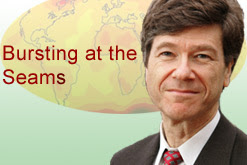
Bursting at the Seams

"Let us not be blind to our differences, but let us also direct attention to our common interests, and the means by which those differences can be resolved. And if we cannot end now our differences, at least we can help make the world safe for diversity, for in the final analysis our most basic common link is that we all inhabit this small planet, we all breathe the same air, we all cherish our children's future, and we are all mortal."

Bursting at the SeamsSo concluded Professor Jeffrey Sachs in the first of this year's Reith lectures this morning, after asking some challenging questions about the geo-political problems facing our generation as a result of living in an unprecedentedly crowded world:

Can it be true that because we don't want to talk to Iran, H5N1 won't pass through Iran, we won't have to deal with avian 'flu in places we don't want to speak to, because we put on pre-conditions to negotiations, that we can't see the commonality of our problems? And can it really be, ladies and gentlemen, that the solution to Darfur, one of the most urgent crises on the planet, is all about peacekeepers and troops and sanctions, when we know that in Western Darfur the rebellion started because this is just about the poorest place on the whole planet, where the rebellion started because there's not enough water to keep people alive, where the livestock have no veterinary care, where there's no basic infrastructure, where a power grid may be a thousand miles away? Can we really think that peacekeeping troops and sanctions will solve this problem?

And how can it be, ladies and gentlemen, that we think we can be safe? We think we can be safe when we leave a billion people to struggle literally for their daily survival, the poorest billion for whom every day is a fight to secure enough nutrients, a fight against the pathogen in the water that can kill them or their child, a fight against a mosquito bite carrying malaria or another killer disease for which there's no medicine though the medicines exist and are low cost but there's no medicine in the village available to save the child and thus a million or two million children will die this year of malaria. How can we think that this can be safe? And how can we choose, as we do in the United States, to have a budget request this year of six hundred and fifty billion dollars for the military - more than all the rest of the world combined - and four and a half billion dollars for all of African assistance, and think that this is prudent? One might say oh it's a science fiction that a zoonotic disease could arise and somehow spread to the world, except that Aids is exactly that. How many examples do we need to understand the linkages, and the common threats, and the recklessness of leaving people to die, recklessness in spirit, in human heart, and in geo-political safety for us?
However, despite Sachs' infectious optimism, like a number of people in the audience, I felt that the kind of "gradual evolution in human institutions" that Sachs is calling for if mankind is to rise to these great global challenges requires too much faith in intergovernmental institutions and a step change in human nature which is simply not going to happen.  Any thoughts anyone?

04 April 2007

Photo of the Day

Mahmoud Ahmadinejad meets the released British sailors,
including Faye Turney.

03 April 2007

Women's Petition Organisers Arrested

As the Iran hostage drama drags on, life continues much as normal for the Iranian population. For two women who were collecting signatures in support of a petition to reform Iranian laws that discriminate against women, this has meant their arrest. Charged with "actions against national security," the two women are members of the One Million Signatures Campaign which aims to educate women in Iran about their legal rights and promote reform of discriminatory laws. This follows the arrest ahead of last month's international women's day of more than 30 women protesters, who were subsequently released.

As we look at the state of the country today, it is worth recalling that a century ago Iran made real advances towards the emancipation of women. In 1906, seven years before our Emily Davison was killed during the Derby after she ran out in front of the King's horse, Iran's Mrs Jahangeer threw herself in front of the Shah's carriage demanding gender equality and warning him to adopt the proposed constitution. In January 1953, the democratically elected government of Mohammad Mossadegh, soon to be overthrown in a joint British-CIA coup, proposed in Parliament to give women the vote, and Iranian women won legal rights before the Revolution that are still rare across the rest of the Muslim world today.

So, if you join the free the navy 15 protest Wednesday evening, spare a thought for the citizens of Iran, who may be mobilised to protest against us Brits*, but are not free to protest about other matters that might in fact be closer to their hearts.

* I often remember a story John Simpson tells of how he walked through a rabid crowd of Iranians chanting "Death to America! Death to Britain!" only to be stopped and asked where he was from. When he hesitatingly responded that he was British, he says the man's visage was transformed to one of friendship as he welcomed John to their country, before turning back to the protest with more chants of "Death to Britain!" That anecdote captures the spirit of Iran perfectly :-)

28 March 2007

15 Captured Sailors Red Herring

At last in the British media, I find a reference (in The Daily Record) to what probably sparked and lies behind this whole episode: "Some in Iran have called for the 15 to be held until the release of Iranian diplomats and at least five Iranians detained by US forces in Iraq for allegedly being part of a Revolutionary Guard force there."

EVENING UPDATE: Some have asked for more on this story. Conveniently, Pepe Escobar has just provided it at Asia Times Online. You can find news of the original arrest of the Iranians at Reuters. Pepe Escobar concludes:

Tactically, as a backgammon or, better yet, chess move - in which Iranians excel - the Shatt-al-Arab incident may be much more clever than it appears. Oil is establishing itself well above US$60 a barrel as a result of the incident, and that's good for Iran. It's true that from London's point of view, the incident could have been arranged as a provocation, part of a mischievous plan to escalate the conflict with Iran and turn Western and possibly world public opinion against the regime.

But from Tehran's point of view, for all purposes British Prime Minister Tony Blair is a soft target. The episode has the potential to paralyze both President George W Bush and Blair. Neither can use the incident to start a war with Iran, although Blair has warned that his government is prepared to move to "a different phase" if Iran does not quickly release the sailors.

If the Tehran leadership decides to drag out the proceedings, the Shi'ites in southern Iraq, already exasperated by the British (as they were in the 1920s), may take the hint and accelerate a confrontation. Strands of the Shi'ite resistance may start merging with strands of the Sunni resistance (that's what Shi'ite cleric Muqtada al-Sadr has wanted all along). And this would prove once again that you don't need nuclear weapons when you excel at playing chess.

Europe's Rights Violations Criticised

Further to the UN's recent failings, the International Helsinki Federation for Human Rights today condemns abuses perpetrated in the name of combating terrorism in Europe, Central Asia and North America. It specifically criticises the UK for expanding its panoply of anti-terrorist laws, "providing inadequate defense to suspects, and extending police and investigatory powers, including the disproportionately long detention period of 28 days without charge."

In addition, Europe's Foreign Affairs Committee criticises the EU's record on human rights protection. It expresses "deep concern regarding the deterioration of the human rights situation" in Iran and calls on the Commission to use the European Initiative for Democracy and Human Rights (EIDHR) to promote cooperation with Iranian civil society.

"Regretting" that the EU has not taken "more unilateral action" to persuade the Sudanese government to accept an international peacekeeping force in Darfur, the report also urges the EU to back "an international peacekeeping force" and "the enforcement of the no-fly zone over Darfur."

27 March 2007

UN Fails on Iran Rights Violations

UNHRCGiven all that is going on in Iran and Uzbekistan, you might be surprised to learn that the United Nations Human Rights Council, which only came into being last year to replace the discredited Human Rights Commission, voted yesterday to end routine scrutiny of human rights abuses in the two countries. According to diplomats, the suggestion was put forward to the 47-state council by a five-country working party including Azerbaijan, Bangladesh and - that bulwark of human rights - Zimbabwe.

Once again, the United Nations proves what it's worth.

24 March 2007

Iran Sanctions

I am reminded of one of my visits to America, about three years ago. On arrival in Los Angeles after an eleven hour flight, passport control was confused as to why I was travelling as a tourist when I had previously held a green card, and so they escorted me to Immigration and Naturalisation Services, where I joined what turned out to be a five to six hour queue for processing (while my wife waited outside the airport with our then 15-month-old and 3½-year-old jetlagged, over-tired children). I was struck by a rebuke I overheard one of the INS officers make to another of the passport controllers: "Just because someone is travelling on an Iranian passport doesn't mean you have to send them to us."

The UN Security Council's unanimously-backed new sanctions, blocking Iranian arms exports and freezing the assets of individuals and companies involved in Iran's nuclear and missile programmes, are clearly necessary and send a clear message to the country's leadership. However, the reality is that they are unlikely to have any real effect and we must be extremely careful how we proceed from here or we will once again find more innocent civilians inconvenienced (or worse) and more civil liberties threatened.

As I have warned repeatedly before, military action against Iran would undoubtedly have the reverse effects to those desired, possibly even rallying the people of Iran behind their hardline president, and economic sanctions would have little, if any, impact, not least because of the money the regime possesses from its oil exports. If the West is to have any positive influence over what happens inside Iran, we need to engage intelligently with the culture's sense of shame. Contrary to the image often cultivated in the Western media, Iranians are extremely welcoming of Westerners, including Americans, and the vast majority seem to desire better relations with us. Treating the state as a pariah, banning travel by its diplomats for instance, would be insulting to the Iranian's national pride and could well accelerate both the people's growing impatience with their choice of leader and the clerical elite's dissatisfaction with what even they reportedly consider as his extremism.