Showing posts with label worldviews. Show all posts

22 December 2007

Belief in Politicians

If George W.Bush prays for guidance on invading Iraq, I want to know that. If (as we now know) Mr Blair would regularly choose biblical texts to contemplate in Downing Street, I want to know that. If a Cabinet minister whose government must take decisions on abortion, or homosexuality, or contraception, or embryo research, belongs to Opus Dei, I want to know that. And if a party leader is an unbeliever, a convinced Christian voter should equally want to know that too.
Following the admission earlier this week by the LibDem's newly-selected leader Nick Clegg that he does not believe in God, Matthew Parris claims in the Times that only two prime ministers in two centuries have been strong Christians.

I'm not sure that I accept all the unspoken assumptions that underlie his analysis and, if anything, would sense a parting of the ways between secular belief and reason (rather than between faith and reason), but I suspect we would all, believers and unbelievers, agree with his desire for greater "honest clarity" in our politicians.

Parris is also right that "in a political leader religious faith is not simply personal." Contrary to what some secularists would have us believe, of course religious belief significantly influences a person's outlook on how society should be structured — just as lack of belief in a creator God and moral absolutes significantly influences the worldview of those who ascribe to the faith of the atheist or humanist. And yet, though we might hope that our elected representatives would "stand up and be counted," I think we all know that's not going to happen.

For one thing, our party machines do not like their members to think freely, let alone express any opinions considered off-message. Prospective candidates unwilling to reign in their personal idiosyncracies tend not to succeed [the likes of Boris Johnson are the exceptions that prove the rule] which is why, to quote one former MP, the upcoming generation of MPs "all look and sound like clones of each other." As is evident from any dictatorship around the world, "honest clarity" often loses out to sheep-like obedience when career prospects are at stake.

For another thing, as long as bureaucracy in our country remains "simply too big and ramshackle to function properly" and our "ministers are trammelled by EU treaties, ineptness and institutional inertia" (as the Telegraph puts it today, explaining why it is Gordon Brown appears to be in control of so very little), what our politicians think and say will make very little difference anyway. Consequently, faith in our increasingly eroded parliamentary democracy will continue to decline — unless our MPs heed the Telegraph's advice: "Put yourselves back in control. Seize power from the gentlemen in Whitehall and Brussels. Scrap the quangos. Abrogate the human rights codes. Make yourselves once again a sovereign Parliament."

Sadly, I fear that anyone waiting for that to happen might just as well believe in Father Christmas...

13 November 2007

Dialogue Or Debate?

Do not miss Adrian Pabst's comments in today's IHT on last month's Common Word letter, which are worth quoting from fairly extensively:

To suggest, as the authors of "A Common Word" do, that Muslims and Christians are united by the same two commandments which are most essential to their respective faith and practice - love of God and love of the neighbor - is theologically dubious and politically dangerous.

Theologically, this glosses over elementary differences between the Christian God and the Muslim God. The Christian God is a relational and incarnate God. Moreover, the New Testament and early Christian writings speak of God as a single Godhead with three equally divine persons - Father, Son and Holy Spirit.

This is not merely a doctrinal point, but one that has significant political and social implications. The equality of the three divine persons is the basis for equality among mankind - each and everyone is created in the image and likeness of the triune God.

As a result, Christianity calls for a radically egalitarian society beyond any divisions of race or class. The promise of universal equality and justice that is encapsulated in this conception of God thus provides Christians with a way to question and transform not only the norms of the prevailing political order but also the (frequently perverted) social practices of the Church.

By contrast, the Muslim God is disembodied and absolutely one: there is no god but God, He has no associate. This God is revealed exclusively to Muhammed, the messenger (or prophet), via the archangel Gabriel. As such, the Koran is the literal word of God and the final divine revelation first announced to the Hebrews and later to the Christians.

Again, this account of God has important consequences for politics and social relations. Islam does not simply posit absolute divisions between those who submit to its central creed and those who deny it; it also contains divine injunctions against apostates and unbelievers (though protecting the Jewish and Christian faithful).

Moreover, Islam's radical monotheism tends to fuse the religious and the political sphere: It privileges absolute unitary authority over intermediary institutions and also puts a premium on territorial conquest and control, under the direct rule of God.
The scary thing is, if I were to ask you whether you thought modern, Western society more closely resembled a relational society or a centralised, controlling one, I think you'd agree we're closer to the latter. Perhaps we really are at risk of losing our Christian roots after all?

01 November 2007

Forget Christmas ... And Forget Democracy

The suggestion that Christmas should be "downgraded" to help race relations, made by the Labour think tank the Institute for Public Policy Research really does defy belief. The leaked report into identity, citizenship and community cohesion suggests, "Even-handedness dictates that we provide public recognition to minority cultures and traditions. If we are going to continue to mark Christmas - and it would be very hard to expunge it from our national life even if we wanted to - then public organisations should mark other major religious festivals too."

The IPPR clearly have no concept of how our national heritage and shared experiences contribute to a personal sense of identity in community. As for the suggestion that "We can no longer define ourselves as a Christian nation, nor an especially religious one in any sense" and that we "should recast the civic oaths and national ceremonies, or institutions like Parliament and the monarchy, in a more multi-religious or secular form and make religious education less sectarian" ... Where do they think the ethical foundation of our legal and political system is rooted - Hans Christian Andersen? Which book do they believe was the inspiration for modern democracy and the human rights we both hold so dear and so take for granted - Aesop's Fables?

How are we supposed to respect any other culture, when we're not even supposed to treasure our own?!

30 October 2007

Our Arabian "Shared Values"

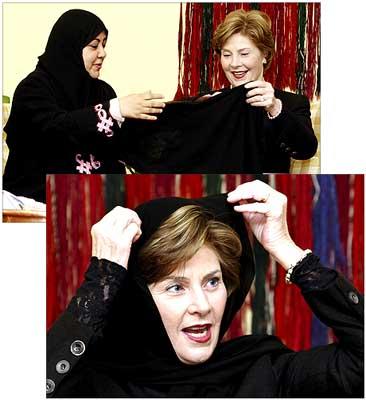
The Huffington Post: Laura Bush Dons Hijab, Will Opprobrium Follow?With Foreign Office Minister Kim Howells suggesting that Britain and Saudi Arabia could unite around our "shared values," I thought I'd see what this year's Country Report on Human Rights Practices said about Saudi Arabia:

The following significant human rights problems were reported: no right to peacefully change the government; infliction of severe pain by judicially sanctioned corporal punishments; beatings and other abuses; inadequate prison and detention center conditions; arbitrary arrest and detention, sometimes incommunicado; denial of fair public trials; exemption from the rule of law for some individuals and lack of judicial independence; arbitrary interference with privacy, family, home, and correspondence; and significant restriction of civil liberties--freedoms of speech and press, including the Internet; assembly; association; and movement. The government committed severe violations of religious freedom. There was a widespread perception of serious corruption and a lack of government transparency, as well as legal and societal discrimination and violence against women. Other religious, ethnic, and minority groups faced discrimination. There were strict limitations on worker rights, especially for foreign workers.
Which somewhat explains why the likes of the Jerusalem Post are upset at America's First Lady, Laura Bush, donning the hijab in Saudi Arabia — as they conclude, it's not exactly a symbol of the freedom and liberty that her husband claims to have spent his presidency trying to introduce to the Middle East.

Irrespective of the cultural significance of the headscarf, Dan Hannan is surely right to observe about King Abdullah's state visit:
"When a free democracy lowers its standards in order to accommodate a sleazy autocracy, the former is diminished and the latter magnified. We are, all of us, slightly cheapened by the readiness of our leaders to appease a handful of rich men. And don’t fall for any nonsense about British jobs, by the way. We pay the same price for Saudi oil that other purchasers do, and they the same price for our luxury goods. Our foreign policy is not, or at least ought not to be, synonymous with the interests of BAE Systems."
I for one am looking forward to the new complete English translation of The Thousand and One Arabian Nights, undertaken by Cambridge University's Professor Malcolm Lyons and due to be published next year, the first since Burton's in 1885.

20 September 2007

Islamic School For Kent

Jamia Mosque in Gillingham [Credit: BBC]Tonight's local news that Muslim leaders are calling for a state-funded Islamic school to be set up in Kent saw me turning to Martin Parsons article in this month's edition of The Difference, examining how Western educational values unwittingly contributed to the rise of Islamism.

The BBC quotes a spokesman for Kent Muslim Welfare Association, Anwar Khan, who runs Islamic classes outside school hours for about 100 children at Jamia Mosque in Gillingham, as complaining, "We run our schools for 10 hours a week - two hours a day, for children across the ages and from different schools. It is an extra burden for them, coming back from school, doing some work at home and having their evening meal and then coming to the mosque."

Parsons concludes his article by considering this very issue of demands from Islamic organisations for state funding of Muslim schools. Let us know what you think:

When Labour came to power in 1997 the government began to approve the creation of Muslim schools in a similar manner to voluntary aided Anglican and Catholic schools. However, the question which needs to be answered is whether these schools are inspired by a philosophy that is compatible with western democracy and seeks to promote tolerance and freedom, or Islamism, which combines western education's critical thinking with Islamic political values?

Labour clearly needs the votes of Islamic groups but doesn’t appear to want all of their agenda. It has been willing to grant some requests – such as government subsidies for courses in Islamic theology and Arabic and considering approval for a Muslim City Academy in Bradford – but has now made a significant u-turn on faith schools. First came an announcement that all faith schools would have to allocate 25% of their places to pupils from another faith or no faith, a proposal that was finally dropped after a concerted campaign by the Catholic Church. Then the government legally required all schools to promote “community cohesion”, with Jim Knight, the Schools Minister, suggesting faith schools should twin with those of other faiths.

Many have suggested that this attempt to create “community cohesion” by targeting all faith schools instead of just Muslim ones is driven by Labour’s desire to hold onto its share of the Muslim vote, which slumped in the 2005 general election. However, there is also a marked secularising tendency in liberal-left politics, coupled with an ideological assumption that the state, not churches or parents, should educate children. The recent vote of the left-leaning teaching union, the NASUWT, to oppose new faith schools well illustrates these ideological assumptions.

Yet whoever heard of voluntary-aided Church of England or Catholic schools in mainland Britain creating problems of community cohesion? They don’t for two reasons. First, because as part of the majority community – 72% according to the last census – voluntary-aided Christian schools by definition cannot create an educational ghetto. Secondly, unlike the Islamic scriptures, the Bible does not set out a distinct political system, still less require one to be imposed on non-believers. Tragically, this is a nettle that the Labour government and other members of the liberal left seem unable or unwilling to grasp.
For more on this issue, also see The Rise Of Islam.

20 June 2007

Not Another Cold War

"We shall pay any price, bear any burden, meet any hardship, support any friend, oppose any foe, in order to assure the survival and the success of liberty."

Asserting that John F. Kennedy overstated his case in his inaugural address in 1961, the International Herald Tribune has an interesting take on last week's speech by President Bush on Communism, Islamism and freedom:

After Sept. 11, Bush replicated the excesses of the Cold War when he established a prison outside the law at Guantánamo Bay, circumscribed domestic civil liberties, encouraged the use of torture abroad, and alienated long-time allies by insisting on invading Iraq without their support.

"Like the Communists, the followers of violent Islamic radicalism are doomed to fail," Bush said. He is right, but why strengthen their cause by abusing human rights and embarking on a divisive military intervention, much like those in the Cold War?

12 June 2007

Islamism Doomed To Fail?

President Bush speaking at the dedication of the Victims of Communism Memorial in Washington"Like the Communists, our new enemies believe the innocent can be murdered to serve a radical vision. Like the Communists, our new enemies are dismissive of free peoples, claiming that those of us who live in liberty are weak and lack the resolve to defend our free way of life. Like the Communists, the followers of violent Islamic radicalism are doomed to fail."

Dedicating a memorial to the victims of Communism in Washington today, President Bush is right to draw parallels between Communism and Islamic radical extremists. He is also right to list as the great lessons of the Cold War "that freedom is precious and cannot be taken for granted; that evil is real and must be confronted; and that given the chance, men commanded by harsh and hateful ideologies will commit unspeakable crimes and take the lives of millions." However, I ask a few simple questions:

Was it inevitable that loyalists and republicans would be reconciled in Northern Ireland?
Was it inevitable that the Soviet Union would collapse?
Is it inevitable that peace will come to the Middle East?
Are the followers of violent Islamic radicalism doomed to fail?


I suggest we would be wrong to presume any such thing. As our elders know all too well, freedom must be fought for in every generation.

04 June 2007

From 1967 To Post-9/11

The publication of Ataullah Siddiqui's Department of Education and Skills report is no doubt correct in its claim that the teaching of Islam in English universities is based on "out-of-date and irrelevant issues," being overly focussed on the Middle East and ignorant of the realities of modern Islam in multi-cultural Britain. However, if we do not understand where our post-9/11 and 7/7 world came from, then we will fail to make any progress either domestically or on the international stage. Therefore, in all that will be said and written over the coming days about the 1967 Arab-Israeli Six Day War, with its inevitable focus on the struggle for peace in the Middle East, I hope the media will also explore the contribution made by the war to the development of political Islam.

Speaking ten days before Israel launched its pre-emptive strike against the Egyptian Air Force on 5th June 1967, Egypt's President Nasser declared, "If Israel embarks on an aggression against Syria or Egypt, the battle against Israel will be a general one and not confined to one spot on the Syrian or Egyptian borders. The battle will be a general one and our basic objective will be to destroy Israel." The trouble was, the Arabs believed him. Their resounding defeat quickly led to the belief that Israel launched the war with the support of Britain and the United States. As one Israeli historian has noted, this now deep-rooted conviction "established a direct link between the 1967 war and former imperialist attempts to control the Arab world, thus portraying Israel as an imperialist stooge."

The failure of Arab nationalism in 1967 thus opened the way for mosques to provide answers to questions that the secular leaders had been unable to deliver and bred a distrust of democracy, which was seen as the heritage of Western imperialism. The political Islamists that emerged were unable to accept the notion of sovereignty in the people for they maintain that sovereignty is only to be found in God—not in people, who are servants of God. Equally, they reject the idea that laws are made by the people, for they hold that laws are God-given in sharia—the divine, immutable Islamic law. With every attempt to "bring freedom and democracy" to the region—and with every failure to deliver on such promises—we have strengthened the hand of political Islam. So it is that just as Israel's victory in 1967 was the beginning of the end of pan-Arabism as an ideology to unite the region and define its people, Israel's defeat in last year's war in Lebanon has given added momentum to the new religious nationalism provided by the Islamist movement.

Contrary to popular myth, 9/11 did not change the world. It merely opened the eyes of many in the West to a struggle that has been brewing for decades. 1967 arguably did change the world. The "realities of modern Islam in multi-cultural Britain" have some of their roots in those defining six days and have been cultivated by our continued frequent mistakes in the region ever since. The proper study of history, not just Islam, is also a "strategic subject" if education is to have a real role "in preventing extremism."

01 June 2007

Cox on British Islamism

"Islamist groups are using our institutions to recruit young people, and preventing any critical analysis of Islam. We need to wake up, draw a line in the sand, and say enough is enough - Britain's cultural and spiritual heritage are under threat."

Thanks go to Cranmer for pointing out an Ynetnews report of these comments by the indomitable Baroness Cox, co-author of The West, Islam and Islamism. Speaking about radicalised British Muslims, the threat to Israel, and the 70,000 capacity mega-mosque in east London, Baroness Cox also quoted a senior British bishop as saying that "most of our educational institutions have been infiltrated." That this is even a problem—let alone one as great as that posed by Communists in our universities throughout much of the last century—seems to have gone unnoticed by the vast majority of our elected politicians. Labour, seemingly oblivious, continues to bend over backwards to appease the Muslim Council of Britain while the leader of the opposition recently suggested that it is a "lazy use of language" to describe the threat from radical, militantly ideological versions of Islam as "Islamist."

Caroline Cox & John Marks: The West, Islam and Islamism: Is Ideological Islam Compatible with Liberal Democracy?Lest any of us need reminding that this ideological struggle is not merely an intellectual debate but also poses a threat to national security, Cox cites the case of Salah Idris, a shareholder in two high-tech security firms that provide security for the British parliament, the Royal Courts of Justice, UK military bases, and eleven nuclear installations—also the owner of a Sudanese pharmaceutical factory destroyed by America in 1998 after it was linked with al-Qaeda activity. Yet Cox claims, "When we brought this matter to the attention of the authorities, we were told there was no cause for concern."

As I wrote a couple of months ago in The Rise Of Islam, "We all need to understand Islam and the differences between moderate Islam and fundamentalist Islam, or Islamism" and it is therefore crucial that the media becomes a positive force for change in inter-religious relations and starts giving a prominent platform to experts such as Baroness Cox who actually understand the threats that we all face in twenty-first century Britain.

30 April 2007

Discover What We Share

Hebrew text   Latin text   Arabic text

Last week I highlighted the need for us all to draw upon and learn from our shared heritage and positive cultural experiences. You will therefore not want to miss the British Library's "Sacred: discover what we share" exhibition, billed as the world's greatest collection of Jewish, Christian and Muslim holy books. Items on display include:
  • A Dead Sea Scroll fragment from AD 50,
  • The Syraic Pentateuch, the earliest known dated Biblical manuscript, written in Turkey in AD 463,
  • The Codex Sinaiticus, the oldest surviving complete copy of the New Testament in Greek, dating from the fourth century AD, and
  • The Ma'il Qur'an, from the first century of the Muslim Hijri calendar (early eighth century AD).
Running until 23rd September, associated events include a free afternoon next Monday with a food and crafts market, art workshops, and performances by the London Jewish Male Choir, IDMC Gospel Choir, the Ameer Khan Qawwali Group, and the whirling Dervish dancer Zia Azazi.

26 April 2007

Linguistic Time-Bomb

As a one-time teacher of English as a foreign language, who established a language school for adults in the developing world, I feel a crucial factor has been missed in today's reporting of the sharp increase in children who do not speak English as their first language.

Take the recently-arrived child in the class where my wife works as a teaching assistant – Fresh off the plane from the other side of the world, barely able to read or write in any language, and not speaking a word of English, he was thrown into a class of nine-year-olds, albeit with full-time one-on-one support. Even though he was no further forward academically than the pre-schoolers soon to move up to reception, he was expected to gain something from the exercise and, presumably, catch up with the rest of the class at some point.

That one in ten secondary school-aged children and one in seven primary school-aged children speak a language other than English at home should worry us profoundly. Not simply because of what it reveals about the transformation that unlimited immigration from Eastern Europe is having on our communities or the pressure that it is placing on housing, the health service, or jobs. Neither should we simply be concerned, as the Commission for Racial Equality policy director warned today, that growing racial segregation in our schools represents a racial "time bomb," that risks exacerbating issues such as the recent wave of violent crime.

When China was first opening up to the West, it issued visas to teachers of English as a foreign language but warned them only to teach English. They did not want any new cultural, political, or economic ideas brought in. What they failed to understand is that a language comes as part of and is inseparable from a whole cultural package. The teaching of a foreign language is one of the most politically subversive actions a person can engage in.

The increasing proportion of children in this country who do not have English as their first language are therefore not simply a significant drain on teaching resources. More than that, it is the cultural divide that we should be most concerned about. Not sharing the language, they will not share the same worldview and will be exposed to a different set of ideas and ideology. If we do not understand the significance of this now, then, like the Communist Chinese authorities, we will one day wake up and discover that we are living in a different country.

24 April 2007

Dialogue of Civilisations

  • What is the role of the Middle East conflict in Jewish-Muslim conversation?
  • Is the media a positive force for change in inter-religious relations?
  • How can local communities be successfully engaged together?
I made reference a couple of days ago to the dialogue of civilisations. The concept of a dialogue among civilisations was originally introduced by the former Iranian president Mohammad Khatami in response to an increasing emphasis on and belief that there exists a "Clash of Civilisations." Khatami's ideas were also the basis for the United Nations naming 2001 as the Year of Dialogue among Civilisations.

Jerusalem's Wailing Wall and Dome of the RockThis civilisational dialogue is usually thought of in the context of Muslim-Christian and Muslim-Western secular relations. However, another often forgotten but crucial dimension is Jewish-Muslim relations. In a new development, Jewish and Muslim organisations met together last week in Brussels and discussed questions such as those listed at the beginning at this post. They also compiled information on partnerships, initiatives and best practice in the field of Jewish-Muslim dialogue in Europe.

Initiatives such as these are crucial in helping to remove mutual prejudices and misunderstandings. Here in the UK, there was a recent conference of rabbis and imams in Manchester, but to date the Government's favoured body for interacting with the Muslim community, the Muslim Council of Britain, has not even recognised Holocaust Memorial Day.

The fact remains that Jews, Christians and Muslims both here in Britain and worldwide have a common history dating back thousands of years. Now, more than ever, it is time for us all to draw upon and learn from our shared heritage and positive cultural experiences.

22 April 2007

Understanding Others

IMDB: House of Sand and FogLast night, thanks to BBC2, I watched a film that I have been meaning to see for a couple of years: Vadim Perelman's adaptation of the Andre Dubus III novel, House of Sand and Fog. I was not disappointed.

A tragic tale of an American divorcee ashamed of letting her family know the mistakes she's made in life and an Iranian Colonel trying to keep his family in the manner to which they were accustomed before they had to flee their home country, the character study provided an insight into some of the differences between Americans and Iranians, their contrasting moral codes and value systems.

The only thing I would have liked to have seen explored further was more about the Iranian family's earlier life in Iran and their forced exile. I felt this was a missed opportunity to provide further insight into the Iranian worldview. Nevertheless, it still compares favourably with Khaled Hosseini's debut novel, The Kite Runner, which similarly provides an excellent portal on Afghan culture. Both are highly recommended for anyone seeking to broaden their understanding of others' points of view in these days of global tension and regional conflict across the Middle East and Western Asia.

IMDB: Bamako ('The Court')On films, I should report back on my post earlier this month about the ten films shortlisted for the human rights film award, FACE (the Film Award of the Council of Europe). The winner was Abderrahmane Sissako's Bamako ("The Court"), in which representatives of African society put the World Bank and International Monetary Fund on trial in a backyard over loan repayments and their role in Africa's economic woes.

13 April 2007

The Rise Of Islam

"Not long before the British surrendered to the Americans at Yorktown in 1781, assurances were still being given in parliament that ‘so vast is our superiority everywhere that no resistance on their part is to be apprehended’. Today, with not even Baghdad secured after over four years of war — and the expenditure of hundreds of billions of dollars — the White House still talks in terms of a ‘victory’ over ‘extremists’ and ‘killers’, even if the delusion that a Jeffersonian democracy can be created in Mesopotamia appears to have been abandoned."

Drawing parallels between George Bush's war in Iraq and George III's war against the American colonists, David Selbourne argues in The Spectator that "the American imperium has entered on its decline after only some six decades" and that it is now "the turn of Islam to assert itself, for the third time in history, across large swaths of the globe."

If he is right, then not only is it imperative that we in the West should understand the contribution of Christianity to Western culture, but we also need to understand Islam and the differences between moderate Islam and fundamentalist Islam, or Islamism.

One of the principal differences between Islamism and Western democracy is in their approach to academic scrutiny. Like the predominant threat against our Western ideals throughout much of the last century, namely Communism, Islamism is intolerant of dissent, looking to and justifying its ideas and beliefs on the basis of an ultimate authority that cannot be questioned. By contrast, ideas in the West are accepted by submitting them to public inspection.

For Islamists, truth and knowledge are thus not to be discovered through open criticism and public enquiry but are represented by the revelation of God to the prophet Mohammed as recorded in the Koran and supplemented by the record of Mohammed's actions and sayings. As far as such Muslim fundamentalists are concerned, Western society is corrupt and weak because it is different from, and therefore inferior to, the perfect society described in their Scriptures – one that dictates, for instance, inequality between men and women and between Muslims and non-Muslims. By denying the equivalent of the separation between Church and State that allowed Western society to flourish, they promise those who accept their worldview not utopia in this life but paradise in the next and promise their martyrs a certain salvation that is unavailable in Islam by any other means.

You may recall a year or so ago when producers of Marlowe's Tamburlaine the Great at the Barbican censored references to Islam in order to avoid the risk of a violent backlash from Muslims to the playwright's scenes in which the hero burns the Koran and says that Mohammed is "not worthy to be worshipped" and "remains in hell." Such censorship was not only a victory for political correctness over common sense but a defeat in our attempt to defend the Western tradition of freedom in the ongoing clash of civilisations that is the wider stage upon which the so-called war on terror is being conducted.

Countries such as Indonesia prove to the world that Islam is able to embrace the concept of individual liberties, such as freedom of expression. We whose societies are founded upon the freedoms imparted by our Christian heritage need to engage constructively with such moderates, seeking to understand their faith from their perspective, if we are to prevent the freedoms that are the building blocks of our way of life from being increasingly eroded over the coming years.