 The American Army already deploys robot soldiers in Iraq. Equipped with tank tracks and automatic weapons, these robotic units, known as SWORDS (Special Weapons Observation Reconnaissance Detection Systems), allow humans to attack the enemy by remote control.
Last week an engineer at the Naval Surface Warfare Centre, an American weapons-research and test establishment, published a set of laws to govern operations by killer robots. Citing the precedent set by the Tomahawk Anti-Ship Missile, CAPTOR Mine, Aegis Ships, automatic Cruise missile defense, and Patriot automated air defense, John Canning made the following proposals:
- Let the machines target other machines
- Specifically, let’s design our armed unmanned systems to automatically ID, target, and neutralize or destroy the weapons used by our enemies –not the people using the weapons.
- This gives us the possibility of disarming a threat force without the need for killing them.
- We can equip our machines with non-lethal technologies for the purpose of convincing the enemy to abandon their weapons prior to our machines destroying the weapons, and lethal weapons to kill their weapons.
- Let men target men
- In those instances where we find it necessary to target the human (i.e. to disable the command structure), the armed unmanned systems can be remotely controllable by human operators who are “in-the-weapons-control-loop”
- Provide a “Dial-a-Level” of autonomy to switch from one to the other mode.
Canning quotes a legal specialist as saying, "We can target objects when they are military objectives and we can target people when they are military objectives. If people or property isn't a military objective, we don't target it. It might be destroyed as collateral damage, but we don't target it. Thus in many situations, we could target the individual holding the gun and/or the gun and legally there's no difference."
Now,
The Economist reports on the research of Ronald Arkin of the Georgia Institute of Technology, who is generating
an artificial conscience for battlefield robots to ensure that their use of lethal force follows the rules of ethics, based on existing ethical decision-making protocols (e.g. the Geneva Convention), rules of engagement, and other ethical and military requirements.
Incidentally, for anyone feeling a little lonely, Mr Arkin is also working on behavioural development for a humanoid robot "with the long-term goal of providing highly satisfying long-term interaction and attachment formation by a human partner." Hardly bears thinking about, does it...?!
So much for Isaac Asimov's three laws of robotics!
![General Dan McNeill [Credit: Al-Jazeera]](http://english.aljazeera.net/mritems/images/2007/9/28/1_229652_1_5.jpg) "KABUL, Afghanistan, Sept. 28 — The commander of NATO said he expects Taliban forces to regroup over the winter in Afghanistan and retake areas previously secured by the British."
"KABUL, Afghanistan, Sept. 28 — The commander of NATO said he expects Taliban forces to regroup over the winter in Afghanistan and retake areas previously secured by the British."
 On Monday, two Russian "Su-type" jets launched a missile that landed just outside the Georgian village Tsitelubani, 60km north-west of the capital Tbilisi, though did not explode.
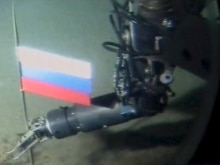 Following its successful Arctic stunt to plant its flag on the seabed 14,000 feet beneath the north pole this week, Russia has again ramped up the
 ![President Bush welcomes British Prime Minister Gordon Brown to the presidential retreat at Camp David [Credit: TimesUnion.com]](https://blogger.googleusercontent.com/img/b/R29vZ2xl/AVvXsEgL3s-li-4iK4i-z7ARCT_K1etU6BUWTAGfaXYVs0EoolPJdrx9ekWErJnTeD-QLUkLGfE-EXVF7g2nLnko3lFCVbbbPSzL8U3v9BHOD-Gt2Ub3ke9bU_UhYn7-K5i9Z3B-o-7caOkU9_Ni/s400/Bush-Brown.jpg)
 So writes Daniel Henninger in today's
 Sex, drugs, and rock'n'roll — The 1960s is the decade most people would most like to live in. Now, it seems, today's "youf" are trying to re-create that bygone utopia of sexual and social liberalisation, but I have to wonder whether they have not forgotten one crucial ingredient: flower power.
 "There are, in a sense, no final victories, for the struggle against evil in the world is never ending. Tyranny and violence wear many masks. Yet from victory in the Falklands we can all today draw hope and strength."
 "A more efficient sword can be found for every shield."
![Britain and America [Credit: ConHome]](https://blogger.googleusercontent.com/img/b/R29vZ2xl/AVvXsEhElKE-VxHgzIB8K9nfMcSeZF1bJej8zM8q0ubJ4_SaKovnpXwbyGrugHAoYArpAJtmmyTcrhLrrc9zMCxdhMNLLDN5brJlk63udiGc3q-3hs8YG51n7GgzdGy24TzG3-useKXt0E3No1I1/s320/britain_and_america.jpg) Over the years, Tony Blair's manifestly lopsided relationship with George W Bush has seriously damaged both the special relationship between Britain and America and our two countries' international reputations. As in
Over the years, Tony Blair's manifestly lopsided relationship with George W Bush has seriously damaged both the special relationship between Britain and America and our two countries' international reputations. As in 


