Showing posts with label Sudan. Show all posts

16 January 2008

Anyone Remember Sudan?

Last summer seems such a long time ago. Riding high on a tide of misplaced hope, the Prime Minister hailed the "historic and unprecedented" UN resolution that we were supposed to believe would bring peace to Sudan. Now, in the cold depths of winter, just a fraction of the promised peacekeeping (sic) "force" have been deployed and government planes continue to drop bombs on Darfur, turning some areas into "no go" zones for aid workers:

Sudanese government planes bombed rebel positions in Darfur, rebels and international sources said on Monday of the latest violence that has turned parts of West Darfur into a "no go" zone for aid workers. [Reuters]
Just last week the Sudanese military admitted that its forces were involved in an attack on peacekeepers in Darfur. America and Britain have again accused Sudan of blocking the UN mission. It wasn't supposed to be this way...

04 December 2007

Teddy Teacher's Homecoming

The Mail's leader says all that is needed over "how Britain has allowed itself to be manipulated and humiliated by a deeply amoral and tyrannical regime" over the Muhammad bear incident:

We have allowed Sudan's rulers to present themselves as behaving mercifully. The two peers who flew to Khartoum will be seen as representatives of our Parliament bending the knee.

The appeasing Foreign Office has been as hopeless handling Mrs Gibbons as it has in preventing the genocide in Darfur.

The Sudanese government, with its Janjaweed militia allies, have murdered 200,000 of their own citizens, and displaced 2million more. But despite endless international hand-wringing, the situation in Darfur is as bad as ever.

Meanwhile, Britain is one of the most generous donors to Sudan. Over the past five years, ministers have provided £333million in aid to the country; this year, we are giving another £110million.

Yet in return, we have neither managed to stop the obscenity of Darfur, nor apparently can we even protect our citizens from politically inspired malice.

Rather than kow-towing to this dreadful regime, we should cut off aid flows, insist that the UN stops dithering and puts a proper peacekeeping force on the ground, and enforce real sanctions on the country.

Dictators will never understand appeasement. Only strength of purpose.

29 November 2007

On Blasphemy & Genocide

Personally, I'd have opted for forty lashes instead of 15 days imprisonment, but maybe Gillian Gibbons didn't have a choice over her punishment for allowing her pupils to name their class bear Muhammad after one of the seven-year-olds in their class — it would have made a far better photo for the world's media.

Given the Government's reaction to genocide in Sudan (not to mention the capture of our servicemen by Iran earlier this year), it is hardly surprising that they have done so little to intervene in what is essentially a political struggle between the various factions that have long been vying for control of the country.

26 November 2007

What's In Another Name?

Rosie Reading Bear on holiday in CambridgeAt half-term my daughter had the privilege of looking after the class teddy, Rosie Reading Bear, and then writing in the bear's diary about what they did together. Six-to-seven-year-old pupils at Khartoum's Unity High School, an independent school for Christian and Muslim children in Sudan following the British national curriculum, were allowed to choose their own name for their bear and came up with a shortlist of eight of their favourite names, including Abdullah, Hassan, and Muhammad. Twenty out of the 23 children voted for Muhammad. Three months later, certain parents have complained to Sudan's Ministry of Education that this is an insult to Islam and the Prophet Muhammad, resulting in the arrest of their British teacher, Gillian Gibbons from Liverpool, and the temporary closure of the school for fear of reprisals. Her punishment could be up to six months in jail, forty lashes, or a fine.

You couldn't make it up, could you?! Reminds me of another Muslim country, where parents are unable to give their children Christian names. I wonder if anyone has considered punishing the twenty mischievous children responsible for naming the bear.

Anyone care to suggest what lesson the pupils may have learnt from the whole affair?

09 October 2007

UN Fiddles While Darfur Burns

Darfur's surge in violence, that saw a town of 7,000 citizens burnt to the ground just a couple of days ago, continues...

A Sudanese army assault killed at least 45 people in the Darfur town of Muhajiriya, where bodies littered the streets amid burned out buildings ... Some analysts say the recent surge in violence in Darfur is an effort by warring parties to gain land before AU-U.N. mediated peace talks in Libya this month. Others said Khartoum may be trying to drive rebels from the peace process. [Reuters]
With Sudan Armed Forces (SAF) gathering in large numbers in at least six towns in northern Darfur, including Tine, Kornoy, Um Baru, and Kutum, further attacks are expected before the peace talks in Tripoli are due to begin, on 27th October.

Yesterday's attack, 130 kilomotres west of that in Haskanita, was allegedly supported by an SAF Antonov, painted white — the colour of the United Nations. Meanwhile, Jan Eliasson, the UN Special Envoy for Darfur is in the Sudanese capital, Khartoum, for talks with Government officials. No doubt he will be as forceful as ever...

07 October 2007

Lest We Forget Sudan

A Darfur town has been burned to the ground and its residents forced to flee, days after 10 African Union troops were killed there in an attack.

More than 7,000 residents of Haskanita fled into the bush or to other towns after it was torched, a spokeswoman for the U.N. said, adding a huge aid operation would be needed to bring them food, shelter and water.

The only buildings to survive were a mosque and a school.

A large armed group attacked a small African Union base in Haskanita on September 29, killing seven Nigerian peacekeepers and three other soldiers from Mali, Senegal and Botswana. [Reuters]
Other news sources add, "Yesterday rebels claimed that Haskanita had been left a smouldering wreck after being levelled by Sudanese troops, with 100 civilians dying in the process."

27 September 2007

Majority Favour Military Intervention

Here are the results of our last poll on military interventionism abroad. From the total number of votes, it is clear that far fewer of you than usual were prepared or felt able to express an opinion either way. However, of those that did do so, a majority were at least in favour of the principle of intervening to prevent genocide or to defend the human rights of others, even if not everyone agreed whether the conditions for intervention had been reached in either Sudan or Zimbabwe. I wonder whether anyone thinks such an approach should be taken to protect the freedom of those protesting against two decades' oppression by the military junta in Burma...?

In 2000, British troops salvaged the UN operation in Sierra Leone. Should we now take military action in either Darfur or Zimbabwe?
Yes, both.  36% (8 votes)
Only Sudan.  5% (1 votes)
Only Zimbabwe.  27% (6 votes)
No, neither.  32% (7 votes)
Total voters for this poll: 22

Make sure you take our new poll on the review of self-defence legislation.

15 September 2007

Responsibility to Protect

Not on our watch - How many times must we say never again?Two generations ago, the United Nations promised in its 1945 Charter, "We the people of the United Nations, determined to save succeeding generations from the scrouge of war..." Just two years ago, in its International Responsibility to Protect Doctrine, it determined that "the principle of non-intervention yields to the international responsibility to protect." More than six weeks ago, the Security Council agreed its "historic" Resolution 1706, later followed by President Sarkozy and Prime Minister Brown's call for action in Darfur.

So why, one might reasonably ask, is it still left down to thousands of grassroots activists across the world to urge the United Nations, "Don't Look Away Now"? The world's fourth Day for Darfur, tomorrow, prompts me to reproduce a letter that I wrote to The Times almost exactly a year ago:

We need action to avoid slaughter in Sudan

The Sudanese Government claims that any UN peacekeepers sent to save lives in Darfur would represent a threat to the country’s national sovereignty.

Yet, for more than a year, 10,000 UN forces have been in Sudan, and the Sudanese Government has made no claim that these troops interfere with its sovereignty. The difference is that, until now, the mandate of these Unamis forces has not included the protection of civilians’ lives.

During its World Summit last September the UN took the bold step of revising the principle of non-interference enshrined in its charter, asserting that it has a responsibility “to help protect populations from genocide, war crimes, ethnic cleansing and crimes against humanity”.

However, in truth, it already had the authority to uphold human rights where member states have conferred sovereignty on the UN through international treaties and covenants. If the UN is going to be able to take effective action against genocidal regimes, then it must now also redefine the concept of national sovereignty.

Sovereignty surely belongs to and is bestowed on governments by the people of a country, and any regime that violates the rights of the people under it so as to strengthen its grip on power should not be considered sovereign.

Failure to address this issue will inevitably mean that the UN will remain paralysed when confronted with obstructive, tyrannical regimes and Sudan will become but the first genocide of the 21st century, not the last.
Note: As I have observed previously, even now that the UN has agreed to send in additional troops, their remit excludes adequate monitoring and enforcement mechanisms, they are to be referred to as an "operation" rather than a "force," and they will only be able to protect civilians deemed to be under threat. So, the Sudanese Government need not worry unduly about its "national sovereignty" being threatened...

31 August 2007

China's Lucky Eights

At 8pm on 8th August 2008, China will showcase itself to what will probably be the world's largest television audience. In response to international pressure and a threatened boycott, the country yesterday announced that it is to withdraw all its support for Robert Mugabe's regime in Zimbabwe except humanitarian aid. The largely unpublicised move represents a significant shift for Chinese foreign policy and holds out hope that they will also soon start making concessions over their support of the Sudanese regime.

Here are the results of our recent poll, which showed a surprisingly high level of support for the boycott proposed by Conservative MEP Edward McMillan-Scott. Keep an eye on the sidebar in the coming days for our next poll!

Should British athletes boycott the Beijing Olympics?
Yes  16% (18 votes)
If no improvement nearer the time  12% (14 votes)
No  72% (82 votes)
Not sure  0% (0 votes)
Total voters for this poll: 114

Sarkozy & Brown's Darfur Push

"It is the combination of a ceasefire, a peacekeeping force, economic reconstruction and the threat of sanctions that can bring a political solution to the region –– and we will spare no efforts in making this happen."

Containers being offloaded by Sudanese army soldiers from a Russian-supplied Antonov 12 freighter aircraft onto military trucks at the military apron of El Geneina airport [Credit: Amnesty International]At first glance, the call in today's Times (and Le Monde) by Gordon Brown and French President Nicolas Sarkozy for intense action to secure a ceasefire in Darfur appears a welcome step towards stopping the genocide in Sudan. They acknowledge that the ceasefire "cannot on its own resolve such a complex conflict" and that "we need a political settlement that addresses the root causes of the violence." They also go further than last month's UN Resolution 1769 in that they threaten "further sanctions against those who fail to fulfil their commitments, obstruct the political process or continue to violate the ceasefire." They are also right to "look beyond Darfur, to the issues affecting Sudan and the region," including the need for better security and greater humanitarian assistance among the hundreds of thousands of people fleeing the conflict across the border into Chad.

And yet, underneath, they seem to be accepting a number of false presuppositions:

  • They describe the weak UNAMID operation as the deployment of a "robust force," though it has no authority to disarm the militias or to pursue and arrest suspected war criminals indicted by the International Criminal Court.
  • They make reference to the meeting of Darfur's rebel groups in Tanzania earlier this month, but neglect to mention that the Sudanese Government's subsequent escalation of violence is already causing the rebels to reconsider attending full negotiations.
  • They also make no mention of breaches in existing sanctions, notably by China and Russia, including photographs (such as the one above) published by Amnesty International just last Friday showing military equipment being supplied by Russia at West Darfur's Geneina airport.
  • Perhaps most fundamentally, they appear to believe that a political solution will be the inevitable outcome of the supposed ceasefire and the recently agreed peacekeeping force, whereas in reality a political solution must be found first if any ceasefire is to hold.
To quote both Rodolphe Adada, the new UN-AU mission head, and Mark Kroeker, the retiring UN police chief, once again, although UNAMID is sure to be one of the main tools for forwarding peace in Darfur, "it's only a peace operation — you need to have peace to keep," and "The countries that have been talking about Darfur need to now do something about Darfur with their deployment of police in probably the most desperate place in the world."

30 August 2007

Sudan Violence Surge

unexploded bomb in Sudan [Credit: DarfurGenocide.org]Just days before UN Secretary-General Ban Ki-moon is due to visit Sudan next week, Darfur rebels have accused the Sudanese government of today bombing South Darfur — but the latest attack in an aerial campaign that has driven thousands of people from their homes over the past month.

Some, such as Democratic front-runner Hillary Clinton, argue, "We should have a no-fly zone over Sudan because the Sudanese government bombed the villages before and after the Janjaweed come and we should make it very clear to the government in Khartoum that we're putting up a no-fly zone. If they fly into it, we will shoot down their planes. It's the only way to get their attention."

However, aid agencies are unanimously against the prospect of a no-flight zone, fearing that Khartoum might respond by forcing them to leave and, even if they were allowed to stay, would almost certainly ground humanitarian aircraft. If this happened, Darfuris would soon suffer lethal food and health crises, as millions who rely on humanitarian assistance for food, shelter and clean water can only be reached by air, with some agencies delivering as much as 90% of their supplies using aircraft and United Nations and African Union traffic accounting for 90% of flights in Darfur. Besides which, given that Darfur covers an area greater than Iraq and that the nearest airfields in Chad are a vast distance from any NATO base, enforcing any no-fly zone would be a phenomenal challenge.

No, as the retiring UN police chief, Mark Kroeker, says, "The countries that have been talking about Darfur need to now do something about Darfur with their deployment of police in probably the most desperate place in the world" — that means us, not just the new joint UN-AU peacekeeping force UNAMID.

07 August 2007

Darfur Blog

Dr Neil Fletcher in Africa: Malnourished child in east Chad

The Health Centre today resembles a cattle market. There are people everywhere. Children crying everywhere. I do a quick triage of women and children sitting on a large collection of mats outside. Right at the back of the queue I notice a little baby that looks very poorly indeed. I usher both mother and child through to my (grim) consulting room. My seat is a chair made of straw. It looks about 30 years old and I'm sure would provide many exciting hours of study for a Microbiologist and his petri dishes! The back of the chair consists of a grubby piece of rope holding together two wooden legs. The baby is nine months old and looks very marasmic and wasted. Just a thin layer of skin covers her ribs. I put a MUAC (mid-upper arm circumference) bracelet on her and it reads ''red- severely malnourished''. Her whole body is moist with beads of sweat. I give her one week's supply of Plumpinut. This is a high-energy ready-to-eat French product that is stuffed with calories and nutrients. In addition I give Mum a mosquito net and a prescription for a collossal dose of Vitamin A, Measles jab, rehydration solution and antibiotics. This child really needs to be admitted and watched by nurses like a hawk. But we just don't have the human resources or capacity. She has her treatment and takes her chances. I arrange to review her tomorrow and spend a great deal of time and effort giving the Mum advice. She is this baby's only nurse. I also insist that Mum doesn't sell the Plumpinut on the market or feed it to her other kids. This does, unbelievably, commonly happen. Mum gives me her word and I fast track her to the front of the pharmacy queue. Onto the next patient.......
Ever wondered what life must be like for the aid workers trying to help Darfur's refugees and internally displaced people? Médecins-Sans-Frontières doctor Neil Fletcher recently started working in Eastern Chad and is keeping a diary online at www.drfletcherinafrica.co.uk

01 August 2007

Brown's "Historic" Sudan Resolution

UN-AU forces

(Send in the Smurfs)

One year ago, the United Nations Security Council passed Resolution 1706, authorising up to 22,500 UN troops and police officers for a United Nations peacekeeping force with the power to use all necessary means to protect humanitarian aid workers and civilian populations, as well as to seize and dispose of illegal weapons.

The new resolution agreed in New York, hailed by UN Secretary General Ban Ki-moon as "historic and unprecedented," makes no reference to this earlier resolution or to the Sudanese Government's refusal to comply with its provisions. It omits any condemnation of Sudan for failing to ensure humanitarian aid reaches those in need, deletes reference to evidence of violations of the UNSC-mandated arms embargo, removes a threat of UN sanctions in the event of continued non-compliance, and drops a request that the Secretary General immediately report any breach of this or previous resolutions and agreements.

Neither does the UN appear to have learned any lessons from last year's failed attempt to deploy UN peacekeepers in Darfur. The new "UNAMID" mission excludes adequate monitoring and enforcement mechanisms, is referred to as an "operation" rather than a "force," and will only be able to protect civilians deemed to be under threat.

Just last week, in its first overall review of Sudan's record for more than a decade, the UN Human Rights Committee reported that "widespread and systematic serious human rights violations, including murder, rape, forced displacement and attacks against the civil population, have been and continue to be committed with total impunity throughout Sudan and particularly in Darfur." Without a political solution, UNAMID is destined to go the same way as Resolution 1706. As the new UN-AU mission head has commented, "I'm sure it will be one of the main tools for forwarding peace in Darfur, but it's only a peace operation — you need to have peace to keep."
Baroness Cox: A Voice for the Voiceless
One thing I find perplexing in recent media coverage is the assertion that this has been a four-year conflict. No mention appears to be made any longer of the previous two decades' violence by the Sudanese regime against its own people — as described by Baroness Cox in A Voice for the Voiceless. The present genocide and obstruction of humanitarian efforts in Darfur differs very little from the bloody civil war that tore the country apart from 1983 to 2005, which resulted in the death of 1,900,000 civilians in southern Sudan, and forced more than 4,000,000 others to flee their homes.

30 July 2007

It's The War, Stupid!

President Bush welcomes British Prime Minister Gordon Brown to the presidential retreat at Camp David [Credit: TimesUnion.com]

George Bush - under enormous political pressure at home - needs to ensure that his voters cannot say that now even the Brits are deserting him. He will know what it is that his visitor needs to go home happy and he will want to deliver it.

Key to that is a war - not the one which Britain and America started but one which they hope to help stop - the war in Darfur. Both men are backing a UN resolution this week which will not merely establish a 19,000 strong peacekeeping force in Darfur and will not only back a peace process between the warring factions but will also offer Sudan a package of long term economic support if it agrees to co-operate - a carrot to accompany the sanctions stick.

For Gordon Brown this would prove that something can be done to tackle what he calls the greatest humanitarian crisis the world faces. For George Bush it would prove that America is willing to act on the world stage to build and not just to destroy.
Nick Robinson seems to think that the rebranded trans-Atlantic alliance might finally bring about decisive and long overdue action in Sudan. Much as I would love to believe it, with the likes of China and the EU still making "more time for diplomacy," I can't see the Brown-Bush summit being that successful.

28 July 2007

The Genocide Olympics

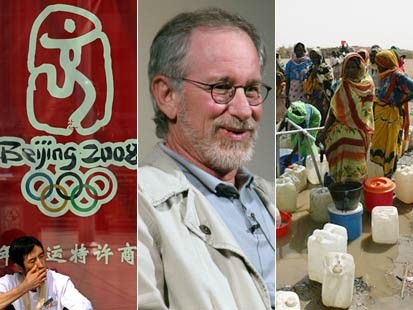
Beijing 2008 Olympics - Steven Spielberg - Darfur, Sudan [Credit: ABC News]Rumours first broken by ABC News a couple of days ago that Hollywood film director Steven Spielberg is threatening to quit as artistic director of next year's Olympics have now been confirmed, although no final decision has yet been taken.

Director of the Oscar-winning film Schindler's List and founder of the Shoah Foundation, which records the testimony of survivors of the holocaust, Spielberg has been working for several months to develop the opening ceremony for the Beijing Games but has been accused of complicity by human rights activists concerned about China's involvement in the Darfur crisis.

China is coming under increasing pressure to improve its human rights situation and to review its economic support of the military regime in Sudan ahead of next year's Olympic Games.

12 June 2007

Good News From Sudan

Despite a decades-long conflict, an aerial survey in Southern Sudan has revealed that wildlife populations are thriving on an order that rivals the migrations of the Serengeti and could represent the biggest migration of large mammals on Earth.

Let's hope the aerial survey of Darfur brings equally good news for the human population under pressure there...

Richard Goldstone, a former justice of the Constitutional Court of South Africa, the chief prosecutor of the UN International Criminal Tribunals for the former Yugoslavia and Rwanda, and a member of the Independent Inquiry Committee into the United Nations' Oil-for-Food Program, today calls for the UN Security Council to institute an embargo on oil revenues to the Sudanese Government. After reflecting on some of the weaknesses and failings of the UN Oil for Food Program in Iraq, he concludes:

"We should not let the perfect be the enemy of the good. Yes, there were weaknesses in the Iraqi program. But many of them could be addressed by simple reforms and better management within the UN. Such an embargo is the best tool that is realistically available to force Khartoum to end the slaughter in Darfur. It would be far better than the bloody status quo."

Evening UPDATE: News is that Khartoum has agreed to a combined United Nations and African Union peacekeeping force of between 17,000 and 19,000 troops and an additional 3,700 police to be deployed in Darfur. Of course, whether it will actually happen is another matter — on the basis of what's become of past agreements, I wouldn't bet on it.

06 June 2007

Eyes on Darfur

"The picture is worth a thousand words, but it's important that it's carried by a million voices!"

While the likes of the European Union, the United Nations, China, and Britain continue to make "more time for diplomacy" rather than take the tough action needed to bring the genocide in Sudan to an end, Amnesty International has launched a new website, Eyes on Darfur, enabling anyone concerned about atrocities being committed in the troubled region to inspect up-to-date, high-resolution satellite images of vulnerable villages. The international human rights group is calling for action on three fronts:

Call on Russia to guarantee security in Darfur and eastern Chad
Darfur and eastern Chad are in urgent need of effective peacekeeping forces to provide security and enforce the arms embargo on Darfur. Call on Russia to take steps to support the deployment of these peacekeepers in Darfur and to work with other countries on the Security Council to strengthen and enforce the arms embargo.

Urge Chad to accept peacekeepers to protect civilians
Thousands of women and girls have been raped, child soldiers have been recruited, whole villages looted and destroyed, and an estimated 120,000 people have been forced from their homes in eastern Chad, some of whom have been desperate enough to escape into Darfur. Urge Chad to accept peacekeepers to protect civilians.

Act to Protect 12 Towns and Villages in Darfur and eastern Chad
Amnesty International has identified 12 villages in Darfur which are in danger of being attacked. Help us take action to prevent more bloodshed.
As well as joining Amnesty's campaign, be sure to watch out for a focus on Sudan in the next issue of The Difference!  And if you haven't yet signed our petition calling for tougher sanctions on Zimbabwe, please take a moment to do so. Thanks for taking action — the more people who act, the bigger the difference we will make!

31 May 2007

More Darfur Dithering

A civilian killed by the Sudanese Government backed Janjaweed militia in Farawyaiah, West Darfur. The soldiers in the background are from the Sudanese Liberation Army. [Credit: Lynsey Addario at Reality Based Nation]"China appeals to all parties to maintain restraint and patience."
Over what, you might ask? Proposed new sanctions against Sudan, which the Chinese claim, "would only complicate the issue" — by which they presumably mean the issue of Chinese economic interests and their sale of weapons and aircraft to Khartoum.

In contrast, President Bush ordered new American sanctions against Sudan on Tuesday and is demanding new United Nations sanctions to pressure the Sudanese government to halt the bloodshed in Darfur. The American President insists, "We will continue to insist on the full implementation of the Darfur peace agreement. We will continue to promote a broadly supported and inclusive political settlement that is the only long-term solution to the crisis in Darfur." However, like China, UN Secretary-General Ban Ki-moon says he wants more time for diplomacy and last month urged Britain to delay a push for tougher sanctions.

Once again, we are left wondering what it will take before the international community takes the effective action that is so desperately needed.

19 May 2007

Beckett Condones Chinese Genocide Support

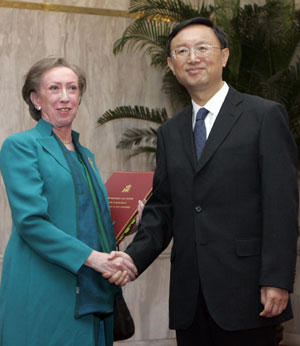
Margaret Beckett with China's Foreign Minister Yang Jiechi [Credit: China Daily]Zimbabwe, Sudan and Burma, three of the world's most oppressive regimes, all benefit from Chinese aid and trade. For instance, China sells the Sudanese government military equipment and purchases two-thirds of Sudan's oil exports. Given the country's economic interests, it is perhaps unsurprising that China should continue to use its veto on the United Nations Security Council to block efforts to send peacekeepers to Darfur.

However, even I am astonished by the support expressed by our own Foreign Secretary, Margaret Beckett, for China's role in financing the Sudanese genocide: "I noticed there have been some criticism of China, but actually China has played a really quite positive role, particularly in the negotiation of the Darfur peace agreement."

One would have hoped that the Foreign Secretary, who is in the middle of a six-day visit to China, would be able to exert some pressure on her Chinese counterpart that it would be in China's interests to adopt a more principled and ethical approach to its foreign affairs. However, Mrs Beckett is clearly even less likely to achieve any results in this area than will Wednesday's call by the United States Congress for China to use its economic leverage with Sudan to stop the violence.

The American resolution noted that the spirit of the Olympics is "incompatible with any actions supporting acts of genocide," but a defiant Beijing is so far rejecting attempts to use the conflict to "politicise the Olympic Games."

28 April 2007

Time is Up - Protect Darfur

Save DarfurAhead of tomorrow's global protests to mark the fourth anniversary of the conflict in Darfur, and clearly not appreciating that the time for mere talk has long passed, Tony Blair has yet again threatened "tougher action" against Sudan's government and rebels if they fail to act to end the crisis in Darfur.

The LibDem's Lynne Featherstone says all that's necessary in response:

"It is clear that what we are witnessing in Darfur is genocide. The British Government and the international community cannot continue to watch as this catastrophe unfolds in front of them. A no-fly zone, a proper and extensive arms embargo, targeted travel bans and asset seizures as well as meaningful sanctions are all essential yet the Government has so far done nothing. What will it take before this country takes the effective action that is so desperately needed?"