Showing posts with label drugs. Show all posts

23 November 2007

Cocaine's Health Time Bomb

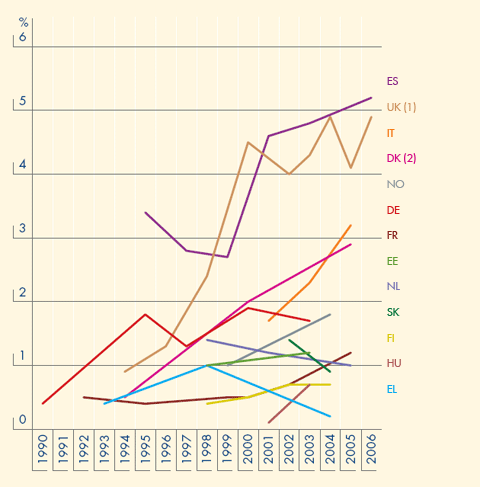
Trends in prevalence of cocaine use among young adults (aged 15–34) in Europe

EMCDDA 2007 Annual report: the state of the drugs problem in Europe: Cocaine and crack cocaineThis year's annual report by the European Monitoring Centre for Drugs and Drug Addiction reveals that the proportion of young Britons who take cocaine has overtaken that of Americans and that, after cannabis, cocaine is now the second most commonly used illicit drug. 4.9% of men and women aged between 15 and 34 used the drug in Britain last year and 6% of teenagers at or below school-leaving age have tried the drug, with many users also using other substances including alcohol, tobacco, cannabis, and other stimulants.

Thus, although cannabis use in the UK has declined slightly (yet is still smoked by one in five people under 24), it has simply been replaced by a more fashionable — and significantly more harmful — alternative. The report's researchers warn that cocaine is a growing public health issue, its most common adverse effects including cardiovascular disorders, strokes, and seizures. Given that no effective medication exists to help cocaine users maintain abstinence or reduce use, more than ever we desperately need a new approach to the Government's failed drugs strategy.

20 November 2007

Drugs Poll Results

Here are the results from our last poll, which asked whether you thought the ABC classification system for drugs should be replaced with an index of harms:

Should the ABC classification system for drugs be replaced with an "index of harms"?
Yes.  50% (11 votes)
No.  32% (7 votes)
Not sure.  18% (4 votes)
Total voters for this poll: 22

12 November 2007

One Flew Over the Cuckoo's Nest?

"There were no beneficial effects — none."

Having learnt earlier this year that there has been almost ten-fold increase in use of behaviour control drugs among under-16s in the last decade and an almost twenty-fold increase among 16-18 year olds in full-time education, a study monitoring the treatment of 600 children with Attention Deficit Hyperactivity Disorder (ADHD) since the 1990s has now shown that drugs such as Ritalin and Concerta are not effective and work no better than therapy.

Perhaps we can now better invest the £28m that is spent unnecessarily medicating around 55,000 children — and those children can start receiving the treatment, attention and discipline that they actually need?

23 October 2007

The Giant of Excess

Attacking last week's Foresight report that claimed individuals could no longer be held responsible for obesity, a leading Government adviser, Professor Julian Le Grand, argues that a completely fresh approach is needed to reverse problems caused by the "excess consumption" of tobacco, of food, of alcohol, of illegal drugs, and of indoor leisure. Suggesting that the new "giant of excess" has arisen alongside the "five giants" identified by William Beveridge when he founded the welfare state — namely, those of want, disease, ignorance, squalor, and idleness — Le Grand says that instead of requiring individuals to opt in to healthy schemes, they should have to opt out to make the unhealthy choice, for instance by being required to buy a smoking permit before being able to purchase cigarettes.

Such "libertarian paternalism" is certainly not as extreme as prohibition, yet it still smacks of Labour's nanny state, so is perhaps not quite as radical as the professor would have us believe. For instance, when I go to work, I do so to work. I would not want my company to be required to designate an hour in the working day as the "exercise hour" — I would rather continue exercising with my family out of work hours. Equally, requiring supermarkets to sell alcohol separately from groceries or restricting the sale of alcohol to off licences would simply inconvenience and annoy customers, not change their drinking habits. As for the idea of the Health Secretary sending parents details of their children's weight measurements at the ages of five and ten, I can not think this is going to make any difference to any family's eating and exercise habits.

What Le Grand's analysis misses is that the state itself has become our biggest giant to be tackled. A truly "completely fresh approach" would involve the Government meddling less and trusting people more. It would require the Government rediscovering for which areas it properly exists and returning responsibility for those in which it should never have made society irresponsible. Only then might we begin having an impact on the symptoms of our broken society.

16 October 2007

Alternative to Misuse of Drugs

Yesterday's controversial proposals to legalise all drugs, made in the thirty page report "Drugs Policy: A Radical Look Ahead?" by the chief constable of North Wales, Richard Brunstrom, have today received further support from a former chief inspector of prisons, Lord Ramsbotham: "I used to reckon that 80 per cent of those people received into prison were misusing a substance of some kind when they came in. The amount of acquisitive crime connected to drug abuse is immense. That is why there needs to be a new approach."

Of course, they are not alone in claiming that drugs policy has been based on "moralistic political rhetoric" rather than evidence. Earlier this year the independent UK Drug Policy Commission reported that both government education schemes and treatment of addicts have had little impact, while the Royal Society of Arts (RSA) suggested that UK drug law had been "driven by moral panic" and was "not fit for purpose." Indeed, the chief constable even quotes John Reid as acknowledging that "prohibition doesn't work" and the Olympics minister, Tessa Jowell, as conceding "it drives the activity underground."

Nevertheless, the Government and the likes of Ken Jones, the president of the Association of Chief Police Officers, have predictably dismissed the proposals. Yet, in calling for the repeal of the Misuse of Drugs Act 1971, Mr Brunstrom is not calling for an "anarchic free-for-all," as some reports seem to suggest. Instead, he proposes replacing the current ABC classification for drugs with a new, scientifically-based "Hierarchy of Harm" including tobacco and alcohol, and decoupled from criminal penalties:

"Drugs and psychotropic substances are simply not going to go away as if by magic. And so, if drugs cannot be eradicated (and the evidence that they cannot is now overwhelming), then the principal object of public policy should be to reduce as far as possible the great harms that they can and do cause."
This is precisely the same as the index of harms classification system for drugs proposed by the Commons Science Select Committee last year and supported by the RSA Commission on Illegal Drugs, Communities and Public Policy when it recommended replacing the Misuse of Drugs Act with a broader Misuse of Substances Act earlier this year. When we read statistics such as that the cost of alcohol and tobacco to the NHS in England is double that of all illegal drugs and that in Scotland in 2004, tobacco killed about 13,000 people and alcohol 2,052, while just 356 died from all other illegal drugs put together, Brunstrom is surely right to dismiss the ABC system as "indefensible, both legally and ethically" and "arbitrary, and subject to politically-motivated manipulation" and to call for a national debate on the issue, isn't he?Credit: BBC 'Drug classification rethink urged'

15 August 2007

End of Happy Hour?

Happy hour"Alcohol is too cheap and too readily available and is too strong. Young people cannot handle it."

Really? Cheshire's chief constable, Peter Fahy, clearly thinks so. Certainly Labour's extension of licensing hours appears to have sent as clear a signal on binge drinking as their declassification of cannabis did on drugs. But would raising the legal drinking age to 21 have any impact on the country's underlying social problems? What do you reckon?

23 July 2007

Our Orwellian State

Mind Control 101 by JK Ellis: How to influence the thoughts & actions of others without them knowing or caringThe news is reporting that the number of prescriptions for antidepressants and other mind-altering drugs given to children under 16 has more than quadrupled in the last decade. As shocking as this statistic is, checking Hansard for the actual answer given to the Liberal Democrat shadow children's secretary, David Laws, reveals that it masks an even more shocking one.

The question asked was: "To ask the Secretary of State for Children, Schools and Families what his latest estimate is of the number of school age pupils who have been prescribed drugs for (a) depression, (b) behaviour control and (c) mental health problems in each year from 1996-97 to 2006-07; and if he will make a statement." The headline summary is that there were more than 631,000 such prescriptions recorded in the last financial year compared to 146,000 in 1996-97 — an increase of more than 4.3 times the figure ten years ago. However, a breakdown of these prescriptions reveals that the increase in use of behaviour control drugs has been almost ten-fold among under-16s and almost twenty-fold among 16-18 year olds in full-time education:

Increase in use of mind-control drugs in the last ten years
 Under 16s16-18s in
full time
education
Antidepressant drugs1.41.1
Behaviour control drugs †9.419.6
Drugs used in psychoses and related disorders3.41.2
All mind-control drugs  4.31.4
† Central Nervous System stimulants and drugs used for
attention deficit hyperactivity disorder (ADHD)

We've got Big Brother, NewSpeak, attempts to lock away the innocent and now mass use of mind control drugs ... and poor George Orwell thought he was writing a warning about, not a manifesto for a future government.

10 July 2007

Highlights From Breakthrough Britain

Iain Duncan SmithWriting in the overview to the Social Justice Policy Group's report, Breakthrough Britain, Iain Duncan Smith says, "Breakthrough Britain advocates a new approach to welfare in the 21st century. We believe that, in order to reverse social breakdown, we need to start reinforcing the Welfare Society. The Welfare Society is that which delivers welfare beyond the State." He identifies two specific areas why their approach is unique: "Firstly, we have recommended a range of policies which are designed to break the cycle of disadvantage in the early years of a child’s life. Secondly, we wish to strengthen families by removing the perverse disincentives in the fiscal system which are an obstacle to stable families."

It is understandable that media coverage has so far focused on the group's marriage and tax-related suggestions. After all, the Government has spent ten years creating a tax and benefits system that perversely penalises married couples, perpetuating poverty for the 76% of children who live in couple households. However, any attempt to heal our broken society will need to change more than just the tax system. Duncan Smith explains the significance of the five pathways to poverty identified by the Group:

"Our approach is based on the belief that people must take responsibility for their own choices but that government has a responsibility to help people make the right choices. Government must therefore value and support positive life choices. At the heart of this approach is support for the role of marriage and initiatives to help people to live free of debt and addiction. Government has to be committed to providing every child with the best possible education and giving the most vulnerable people the necessary support to enter active employment. The problems of family breakdown, drug and alcohol addiction, failed education, debt and worklessness and dependency affect us all, either directly or indirectly, as Breakdown Britain showed."
The Difference offers the following list of highlights from the report that it is hoped will receive due attention in the coming hours, days, and weeks:

Family Breakdown
  • Relationship education in schools
  • Creative ways for delivering more respite care
  • Targeted assistance for parents who currently struggle to nurture their children, rather than steering them towards local authority childcare
  • Removal of the bias towards state-provided childcare.
  • A review of family law conducted by a dedicated independent commission
  • Reinstatement of the use of ‘marital status’ in government forms and statements
Economic Dependency
  • Clear work expectations must be attached to the receipt of benefits for people who can work
  • Back-to-work services should be state determined but not state delivered
  • A serious and thorough review of the Housing Benefit system is needed
  • Parents should be given the opportunity to front-load child benefit
Educational Failure
  • £500 p.a. educational credits for disadvantaged children to fund supplementary educational services such as a year’s extra maths tuition, six months intensive literacy support and a year’s group music lessons
  • An end to bureaucratic overload
  • ‘Booster classes’ for pupils falling behind
  • More alternative provision to pupil referral units
Addiction
  • An integrated addiction policy to replace the separate drugs and alcohol treatment
  • A devolved responsibility to local Addiction Action Centres
  • An expansion of third sector proven provision of ‘holistic’, value added, abstinence-based treatment
Serious Personal Debt
  • UK credit unions should be strengthened, supported and expanded
  • Local community based debt advice should be supported
  • The benefits system and Social Fund should be reviewed in detail
  • Education in personal finance should be improved
Third Sector
  • Gift Aid should be made easier to claim
  • Introduce Charitable Remainder Trusts as tax-efficient vehicles for planned giving
  • Launch a 'V Card' reward scheme to boost volunteering
  • Greater third sector delivery of public services
  • Less bureaucratic and prescriptive Government funding
  • Introduce voucher schemes to empower users of government-funded services
  • Enhance the third sector's voice in Cabinet and Parliament
  • Create a level playing field for faith based organisations
Yes, all this will come with a cost. But, as the report also notes, social breakdown presently costs the UK £102,000,000,000 per year, or around £3500 per taxpayer — that's a lot of money that could be better invested.

26 June 2007

Sowing Instability

The Failed States Index 2007 Map"It is an accepted axiom of the modern age that distance no longer matters. Sectarian carnage can sway stock markets on the other side of the planet. Anarchic cities that host open-air arms bazaars imperil the security of the world’s superpower. A hermit leader’s erratic behavior not only makes life miserable for the impoverished millions he rules but also upends the world’s nuclear nonproliferation regime. The threats of weak states, in other words, ripple far beyond their borders and endanger the development and security of nations that are their political and economic opposites."

Foreign Policy magazine: The States That Fail UsIn publishing the third annual Failed States Index, Foreign Policy magazine and The Fund for Peace assert that the world's weakest states aren't just a danger to themselves, but threaten the progress and stability of countries half a world away.

As if to prove the point, the latest World Drug Report confirms how events on the other side of our global village are devastating lives on our own doorsteps. We already knew that last year's bumper opium crop in Afghanistan meant the country had become the source of 92% of the world's supply of opium. We now learn that opium cultivation in the country involves one in eight (12.6%) of the population and that 50% of the heroin on Britain's streets comes from Helmand alone, the province supposedly under British control.

Afghanistan's record poppy yield and drug trafficking routes, fuelled by underground heroin factories, bring crime, addiction, and HIV/AIDS in their wake. The industry finances the activities of the Taleban, against whom the 7,700 troops we have deployed in the country are fighting. Britain's new ambassador to Afghanistan, Sir Sherard Cowper-Coles, already believes we could be heavily involved in Afghanistan for decades to come. Once again, if we are to have any hope of bringing stability to the region, we must give serious consideration to the Conservatives' suggestion to license the Afghan opium poppy crop.Afghanistan's Drug Trafficking Routes - Sowing Instability

15 June 2007

Sex, Drugs But No Power

Sex, drugs, and rock'n'roll — The 1960s is the decade most people would most like to live in. Now, it seems, today's "youf" are trying to re-create that bygone utopia of sexual and social liberalisation, but I have to wonder whether they have not forgotten one crucial ingredient: flower power.
The Independent Advisory Group on Sexual Health and HIV (IAG) says there is an indisputable link between alcohol, drugs and risky sexual behaviour, describing the threat as fuel for a sexual health crisis. Given the failure of the Government's Teenage Pregnancy Strategy, drug policy, and approach to teenage binge drinkers, this should come no surprise.

Noting that sexual health in the UK has been deteriorating over the last twelve years, the group warns that young people are starting to have sexual intercourse at a younger age, are becoming more promiscuous in their behaviour, and have the highest rate of sexually transmitted infections and teenage pregnancies in Europe. Their report asks, "As adults, are we reneging on our responsibilities?"

Rather than answer what seems a blindingly simple question with a blatantly obvious answer, I want to turn the query around: Are today's youth reneging on their responsibilities? If they've rediscovered the sex (earlier and riskier) and the drugs (stronger and more dangerous), why haven't they stumbled onto rock'n'roll? They've got their Vietnam (Iraq), so where are the non-violent anti-war protests? They've got their nuclear causes (renewal of Trident and next generation of power stations), so where are the sit-down demonstrations? They've got their gun crime and armed police, so why is nobody giving flowers to policemen?

The IAG claims "young people do not engage in risky behaviour: they experiment and explore" but I'm not convinced ... It seems to me that Generation Blair has missed the point.

09 June 2007

Reefer Madness

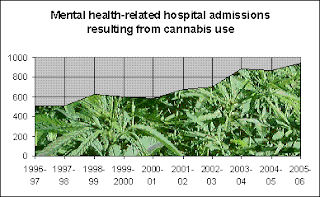
Mental health-related hospital admissions resulting from cannabis useAnybody else notice a trend?

About 10% of cannabis users become addicted and are at risk of oral and lung cancer and reduced fertility, as well as mental illnesses such as schizophrenia and depression. The government claims it has been perfectly clear on cannabis, saying it is harmful, is an illegal drug, and should not be taken—which is clearly why they downgraded it from a class B to a class C drug three and a half years ago.

It is time Labour accepted that its drug policy has failed and we adopted a new index of harms classification system for drugs, as proposed by the Royal Society of Arts and the Commons Science Select Committee.

Source: Hansard

23 May 2007

Iraq Turns To Drugs

The Independent: Opium: Iraq's deadly new exportAnyone concerned about the flood of cheap heroin coming to Britain from Afghanistan will want to read today's frontpage story in The Independent.

The paper reports that "Farmers in southern Iraq have started to grow opium poppies in their fields for the first time, sparking fears that Iraq might become a serious drugs producer along the lines of Afghanistan." It carries two warnings. Firstly, that although the shift to opium cultivation is still in its early stages "there is little the Iraqi government can do about it because rival Shia militias and their surrogates in the security forces control Diwaniya and its neighbourhood." Secondly, "given that they can guarantee much higher profits from growing opium poppies than can be made from rice, many impoverished Iraqi farmers are likely to cultivate the new crop."

Once again, what have we done?

18 April 2007

Government's Drugs Policy Fails

As the government's ten-year drugs strategy draws to an end, the independent UK Drug Policy Commission reports that education schemes have had little impact and any benefits from treatment of addicts have been, at best, limited because so many drug users had relapsed or gone untreated.

Just last month the Royal Society of Arts claimed that UK drug law had been "driven by moral panic" and was "not fit for purpose."  Coming at a time when heroin from Afghanistan is increasingly available at ever lower prices, a radical rethink is clearly necessary.  Given that no other country in Europe faces the same level of problem as we do in this area (our addiction rates are double those found in France, Germany, the Netherlands, and Sweden), surely we can learn from and adopt the best practice of others?  After all, we are clearly not alone in the struggle against drugs and you would have thought that living on an island would have certain advantages as regards the supply side of the problem, if we had proper border controls.

Does anyone have knowledge or experience of what works or helps elsewhere that you could share with us?

08 March 2007

Drugs - Facing Facts

The Royal Society of Arts (RSA) says UK drug law has been "driven by moral panic" and is "not fit for purpose."

Following calls on this blog a couple of days ago for a new approach to dealing with the drug problem at its origin, it was a welcome start to the day to hear the former Conservative leader Iain Duncan Smith on the Today programme, who said the report was "worryingly complacent."  While the RSA calls for a switch in emphasis from criminalising offenders to harm reduction, Duncan Smith said we need to go further, learning from what has succeeded in other countries and focusing on rehabilitation.

The RSA Commission on Illegal Drugs, Communities and Public Policy also recommends replacing the Misuse of Drugs Act with a broader Misuse of Substances Act and substituting the existing ABC classification system of drugs with an "index of harms," similar to that proposed by the Commons Science Select Committee last year, which would include alcohol and tobacco.

Credit: BBC 'Drug classification rethink urged'

06 March 2007

Afghanistan Already A Narco-State

Afghanistan's Opium Harvest 2001-2006
Even two years ago, the Afghan Independent Human Rights Commission was lamenting the fact that Afghanistan had already become a narco-state. Today, the country's drugs trade accounts for about a third of Afghanistan's economy and last year's opium harvest of 6,100 tons was 50% higher than the previous two years record levels and three times higher than the level before the Taleban banned production. Under the Taleban, production in 2001 fell to just 185 tons, but then we went to war.

Without adequate international investment for reconstruction, the country has become the source of 92% of the world's supply of opium and the source of at least 90% of heroin on British streets. This means that it’s not a problem that we can simply dismiss as being on the other side of the world. Attempts to destroy the crop have clearly failed (no more than 10% of the crop has been eradicated since we ousted the Taleban) – unsurprisingly, given that it is such a lucrative trade for all involved. A good proportion of Afghanistan opium is smuggled out through the former Soviet republic of Tajikistan, where I used to work. I recall being reliably informed by one of my government contacts there that when the chief of police arrests someone smuggling 1.5kg of drugs, he records just 1kg in the official records – efforts to restrict the trade are as affected by the culture of corruption as every other area of life.

It is high time therefore that we give serious consideration to other options, such as the Conservatives' recent suggestion that Afghan opium poppies should be purchased to make pharmaceutical products such as diamorphine, a pain-reliever used after operations and for the terminally ill, which is in short supply.

The US drug enforcement agency has previously noted that the opium industry is financing terrorism, subversive activities, and warlordism. If our troops are to have any chance of success in Afghanistan, and if we are to get a grip on the cheap drugs that are such a blight on society here in the UK, we cannot continue pursuing the same policies that have failed us so miserably since 2001. Otherwise, United Nations fears that this year's opium harvest will be even greater than last year's bumper crop will be realised.