Showing posts with label NHS. Show all posts

08 January 2008

Umbilical Cord Blood Use

MP David Burrowes wants doctors to offer parents the option of storing their baby's umbilical cord blood. At present, the NHS takes about 2,000 samples each year and around 10,000 people are said to have been cured of blood cell disorders using this cord blood. However, there have been cases where the cord blood bank has struggled to find matches, especially among ethnic minority groups. From that perspective, increasing the size of the bank seems like a sensible proposal.

I note, though, that it is also hoped that the stem cells contained in cord blood might one day be used to treat diseases such as leukaemia, Alzheimer's and Parkinson's. Given the questions that many still have over stem cell research, as with proposed ideas to tackle the shortage of organ donors, there is an issue of presumed consent. There would therefore need to be a clear distinction made between permission for storage only and additional permission for use of the cord blood in research.

01 January 2008

NHS Bill of Rights

A new constitution for the NHS, proposed by the Government, would set out for the first time the rights and responsibilities linked to entitlement to NHS care. However, as we enter the year of the health service's 60th anniversary, does transforming it into "an NHS which is more personal and responsive to individual needs" really mean it will cease being free at the point of delivery for all and become a conditional provider of health services — more personal and responsive only to the needs of those who do not struggle with issues such as over-eating and smoking? Or, if the NHS is to survive, is this a necessary compromise in an age when an increasing number of patients expect their taxes to entitle them to access an ever-increasing range of expensive treatments and an ever-increasing choice of optional extras?

29 November 2007

The English Patient

Despite last year's report by Derek Wanless urging the Department of Health to reconsider its policy of means-testing for care such as washing, dressing and cleaning, Health Secretary Alan Johnson still believes Scotland is wrong to provide free personal care for the elderly, prompting Labour MP Charlotte Atkins to accuse him of giving English patients "a raw deal" compared with those in Scotland.

Whatever happened to an NHS free at the point of use? Going the same way as the NHS dentist? Has Labour abandoned its post-war vision of "cradle to grave" welfare-state reform, of which it was until fairly recently so proud?

03 November 2007

NHS Independence

Criticising Conservative proposals to make the NHS independent, Health Minister Ben Bradshaw says, "It is simply wrong to suggest that taxpayers should invest £90bn in the NHS but there should be no political accountability for how that money is spent."

Indeed! In truth, what is wrong is that the Government should throw so much of taxpayers' money at the NHS but without giving the medical professionals the freedom they need to look after their patients properly. Since we learnt about the death of ninety patients from C.difficile at Maidstone and Tunbridge Wells NHS Trust, I have heard two first-hand stories revealing a life-threatening lack of care and attention to detail.

The first went in to have a kidney out. When asked to sign the paperwork authorising the operation, my lawyer friend decided to read the details of what he was about to authorise. Noticing that it stated the left kidney was to be removed, he queried surely it was his right kidney that was the problem. His question was dismissed but when he persisted, a check was made. Sure enough, they had been about to operate on the wrong kidney ... a minor detail.

The second, just a couple of days ago, was to undergo a minor procedure but was turned away because he has MRSA — something that was detected and recorded in his medical records while he was in for a hernia operation earlier in the year but was left untreated with the patient, unaware of being a carrier, discharged into the community. Again ... a minor detail.

This is what the government healthcare watchdog means when it criticised the trust for "focusing too much on balancing the books and meeting waiting-time targets, at the expense of patient care and infection control." This is the consequence of Government targets, unprecedented cuts in the number of acute hospital beds, and a shortage of nursing staff.

It is time the NHS was freed from political tinkering. Let us hope that Gordon Brown is still happy to adopt Conservative proposals as he formulates his "vision" and that the Conservatives' draft NHS (Autonomy and Accountability) Bill becomes Government policy.

11 October 2007

Treating Symptoms Not Causes

As anyone who has seen today's news will know, following the deaths of 90 hospital patients from Clostridium difficile, Maidstone and Tunbridge Wells NHS Trust has been seriously criticised for focusing too much on balancing the books and meeting waiting-time targets, at the expense of patient care and infection control.

If Kent police have launched an investigation into whether the trust should be prosecuted for the deaths, who is going to challenge the Government for imposing its misguided and distorting targets in the first place? It's time the state stopped interfering in our public services and returned power back to the professionals who work in our local communities.

<exasperation>!</exasperation>

20 September 2007

NHS Needs Competition

Rudy Giuliani meeting Gordon Brown [Credit: ABC News]

"Healthcare right now in America - and I think it has been true of your experience of socialised medicine in England - is not only very expensive, it's increasingly less effective. I had prostate cancer seven years. My chance of survival in the US is 82%; my chance of survival if I was here in England is below 50%. Breast cancer is very similar. I think there's something to the idea that there are many more private options driving the system that create altogether better results."
Nothing quite like a reality check from the Republican presidential front-runner Rudy Giuliani, former mayor of New York ... Wonder what Gordon Brown made of that?

03 July 2007

The Elderly - Who Cares?

The Welfare State We're In - Doctor and elderly patientThe NHS Blog Doctor has a brilliant dissection of today's Times article, Who cares? Both the article and the good doctor's response are rather long, but here's his conclusion:

The NHS was set up and funded to deal with illness, not old age. The problem in the UK is that the Welfare State mentality has turned us into a nation of welfare payment scroungers. Why do families in this country not take responsibility for their own elderly? Why should the taxpayer pick up the bill for the social care of elderly, wealthy businessmen?

Why do we not care for our own elderly relatives? It can be done. Some British families do it. Families of Indian and Pakistani origin. I have never, in all the time I have been practising medicine, heard an Indian or Pakistani say “We cannot look after mother because we have jobs and families of our own” Somehow, they manage.

My practice looks after three large old people’s homes and an EMI [Elderly Mental Illness] unit.

There is not a single patient of Indian or Pakistani origin in any of the old peoples’ homes. There is one hopelessly demented elderly Pakistani lady in the EMI unit. She probably gets more visits than the rest of the patients put together.

There must be moral in this.

20 June 2007

Socialism Vs Social Responsibility

Conservative Policy Group proposals for the NHSLet those who claim that all political parties are the same and it makes no difference who we vote for make an appointment with their local GP and ask what they think.

Last week, health secretary Patricia Hewitt claimed that handing over the NHS to an independent board would turn the health service into a "1960s nationalised industry." Today, the Conservatives pledge to hand day-to-day control of the NHS to an independent board, devolving power from Whitehall to the doctors, nurses and other professionals running Britain's front line NHS services.

Who says the ideological battle with socialism is a thing of the past? The case for social responsibility as an alternative to state control has only just begun!

12 June 2007

PFI: Public Fleecing Initiative?

"These long term debts are distorting clinical priorities now, they are distorting our ability to treat patients."

This is the verdict of a leading member of the British Medical Association on debts accumulated by hospitals under the Private Finance Initiative (PFI). Even supporters of PFI say it could lead to the "wrong services in the wrong places" for local patients and note that there are already one or two PFI hospitals where wards and wings are standing empty because nobody wants to buy their services.

Last year the Government was forced to reveal that eventual repayments for 83 PFI hospital building projects worth £8billion would total £53billion—it would have been far cheaper to use normal borrowing. Yet, it's not just the NHS that is suffering the consequences of these rushed schemes. I know of a leading autistic centre attached to an excellent primary school that shares a site with a secondary school and a special needs school. The secondary school completely rebuilt on a vacant part of the site, which should have made room for the special needs school to relocate to the secondary's old location (a reshuffle that would also have alleviated a dire parking problem). This, in turn, would have allowed the special needs buildings to make way for new build for the autistic centre — something that is desperately overdue, as the wind literally blows through the holes in the walls and even eight years ago the structure was condemned as unfit for purpose. However, the secondary school rebuild was constrained by a PFI arrangement, so now the council needs to finance the scheme or be burdened with an impossible debt. The simplest way for them to do so is to build new houses on part of the site, at the expense of re-development for one of the schools—most probably the autistic centre. So, in this case it is not patients but pupils whose service is being hindered and not doctors but teachers who are left frustrated and demoralised.

Remember what Labour's one-time leadership hopeful John McDonnell told hustings last month about a PFI school in his constituency? "We opposed the PFI but it was imposed upon us. It's run by Jarvis. We can't afford the school rooms after half past five. The local police who want to run a football competition can't use it at the weekend for the local kids because they can't afford it. We can't even have the rehearsals for our drama classes in the evening for our school kids because the Jarvis prices are so high. That's the implications of PFI in many of our areas."

The silver lining is that PFI isn't bad for everyone involved, as construction companies are making a return of 58% on some of their NHS PFI schemes — better profits than on their main business.
Andy Vine cartoon: Special Offer - Instant cashback on all PFI-PPP products - Guaranteed to make your cat fat! - 'Choices ... choices which flavour would best appease the greedy little rascals?'

06 June 2007

NHS "On Its Knees"

A year ago Health Secretary Patricia Hewitt staked her job on wiping out the NHS debt. Apparently the Government is to announce today that she has succeeded, but at what cost?

  • Deficits of £1,300,000,000 run up by a third of hospitals and primary care trusts hidden by making cuts and taking money from elsewhere.
  • The recent loss of 22,300 health jobs
  • Almost three-quarters of newly-qualified nurses unable to secure jobs
  • The complete failure of the new online job application system for junior doctors, the Medical Training Application Service (MTAS).
  • A reduction of 9,000 beds in hospitals.
  • A record number of injuries and deaths in maternity care.
  • A steep rise in hospital infections.
  • Two-thirds of dentists turning away patients as two million patients are now without access to an NHS dentist.
Patricia "the NHS has just had its best year ever" Hewitt may be right that 90% of patients are happy with the service they receive from NHS staff. However, that does not mean that 90% of patients — let alone 90% of NHS staff, or even 90% of the general public — are happy with their local accident and emergency departments, community hospitals, and maternity units being forced to close. No wonder the leader of Britain's 33,000 hospital consultants is claiming the NHS is "on its knees" and warning that only if doctors are given the authority to organise a recovery will the NHS be saved from its current crisis.

26 May 2007

NuLab's NHS 2

Much has been said and written about the death of Penny Campbell, who consulted eight doctors over Easter in 2005 before dying of blood poisoning following a routine operation. Much of it appears to direct blame at the out-of-hours service provider Camidoc. However, as Wat Tyler makes clear at Burning Our Money, the real blame lies with the Department of Health and the new GP contract negotiated by the Government three years ago, which allowed GPs to opt out of their former responsibility for night and weekend healthcare cover but provided patients with no adequate alternative.

What should be done now to prevent further unnecessary tragedy? We could see what ideas the incoming Prime Minister, the man who has been in charge of British domestic policy for the past 10 years, has: "The health service has got to be there for people when they need it and we need to do better in the future." Then again, we could listen to the experts — This is what the NHS Blog Doctor suggested earlier in the year:

Here is the Crippen “back of envelope” plan for improving primary health care. Scrap all the targets. Use the money to pay incentives to GPs who provide wide availability.
  • a “before work” surgery from 7.00 am to 9.00 am
  • an “after work” surgery from 7.00 pm to 9.00 pm
  • a lunchtime surgery from 12.00 to 2.00 pm.
  • surgeries on Saturday and Sunday through-out the day
Any other thoughts anyone?

14 April 2007

NuLab's NHS

Have you seen the report in The Times about the hospital in Birmingham that has been reusing dirty bed sheets instead of giving clean linen to every patient in a bid to reduce its annual laundry bill?  Bringing the vast saving of just 0.275 pence for every sheet re-used, the hospital recorded 36 cases of MRSA in the nine months to January.  Talk about penny-pinching – yet, this is the kind of lengths that professional doctors and nurses have been driven to by ten years of incompetence and mismanagement under NuLabour!  Lengths that, once again, are directly putting people's lives at risk.

You may recall the story last month about a crisis in maternity care that has caused a record number of women to die or be harmed as a result of childbirth.  Well, the NHS Blog Doctor picks up the story with a lot more detail.  Commenting on Patricia Hewitt's response to a recent article in the Guardian on maternity care, the blogosphere's Dr Crippen notes, "That a Cabinet minister, responsible for one of the most important government departments, should be replying personally to articles in a newspaper is a sign of desperation. That the reply should be so breathtakingly duplicitous both demeans her office and calls her probity into question. I suppose we should be used to it by now."  It's quite a long post but worth the read.  He concludes:

Patricia Hewitt’s reply might be acceptable from a government which had been in power for ten weeks. They have been in power for ten years. The time has passed for more promises of more action to be taken in the future.

After ten years, the people of this country are entitled to ask not what will be done, but why it has not already been done.
We are desperately short of midwives

We are short of medically trained obstetricians

We are short of maternity units.

We may be doing better than Chad, but more mothers and babies are dieing during or shortly after labour since this government came to power.

This truly is new labour.
Sunday UPDATE: A Royal College of Nursing report, Our NHS - Today and Tomorrow, is also warning that the NHS debt crisis is "real and entrenched" and claims that 22,300 health jobs have been lost in the last 18 months and almost three-quarters of newly-qualified nurses have been unable to secure jobs. When's the rot going to stop?

04 April 2007

IVF Debate

HFEA: The best possible start to lifeJohn Humphrys noted this morning that having children is not a right. Given that:

  1. IVF carries serious long-term risks for both mother and any children arising from the procedure especially, we learn today, if multiple eggs are implanted,
  2. Infertility is not a condition that poses any risks or handicaps to the individual or couple affected, and
  3. There are approximately 4,000 children currently waiting for adoption placements in the UK,
I do wonder whether NHS resources (i.e. money raised from tax-payers) ought not to be focused on those who are suffering from genuine illness and disease.

31 March 2007

NHS Cancer Care

In light of today's story that older women with breast cancer get poorer care than younger women and Thursday's report that two thirds of health staff would not be happy to be a patient in their own NHS trust, I feel I must point you to the NHS Blog Doctor who has today posted A tale of two cancers, which begins:

Mr R and Mrs D live within five hundred yards of each other. They have never met, but they have much in common.

They both have lung cancer with secondary spread.

They were both treated at the respiratory medicine department of the local District General Hospital, and they were both referred to the same radiation oncologist Dr M.

The final thing they have in common is that Dr M has recommended that they should each have a course of Tarceva.
I'll let you go the the good doctor's blog to see how the story develops. As you might fear, however, it doesn't have a happy ending: "After the second consultation, I had to walk up and down the corridor for a while."

No wonder this week saw a leading expert on modern day management of cancer calling for NHS patients to be allowed to top up cancer care in the private sector.

28 March 2007

NHS Dental Crisis

Last Monday, I made reference to how the majority of us have been left without access to an NHS dentist as a result of Labour's botched reforms and failed contracts. This week we have three surveys confirming what we all already knew from our own experience: that Tony Blair has failed to deliver on his 1999 pledge that by September 2001 "everyone in the country will be able once again to see an NHS dentist just by telephoning NHS Direct."

First, a Which? survey of dentists found that two-thirds were turning away patients because local health bosses are running out of cash.

Now today, the British Dental Association has found that 85% of dentists do not think the government's reforms have improved access for patients and Citizens Advice says two milion patients do not have access to an NHS dentist and are forced to go private, go on waiting lists or do without.

Worse still, 95% of dentists feel less confident about the future of NHS dentistry than they did two years ago. The government, of course, claims that improvements are being made ... just don't ask where.

19 March 2007

Supermarket Supersurgeries

Government plans add substance to last year's rumours that Sainsbury's is poised to become the first supermarket with GP surgeries. You can see it now, can't you: "That will be £30 for the petrol, £50 for the cigarettes and wine, £25 for the microwave dinners and cakes, and I can book you an appointment with the nurse for 9.30am tomorrow."

If the trend continues, perhaps Blair will belatedly fulfil his promise of nationwide NHS dental care to the majority of us around the country who have been left (as a result of his botched reforms and failed contracts) without access to an NHS dentist?

18 March 2007

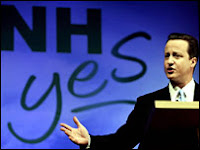
Can Dave Save the NHS?

NHYes - Credit: BBCIn his closing speech at the Conservative Party's spring conference, David Cameron has pledged to end the targets and "pointless reorganisations" that have done so much damage in recent years to the NHS.

That will come as good news to the friend I was talking with just an hour ago who is involved with the Commission for Patient and Public Involvement in Health. She is utterly disillusioned with the constant reorganisations that have meant the key people that they are supposed to consult with are always changing and that their views so often appear to be ignored or not even sought, such as over the recent decision suddenly to end community nurses with just three weeks notice.

The question is how to balance the independence that doctors and nurses need with the accountability expected of any service in receipt of public funds.

15 March 2007

Home Office Targets Distort Policing

A former Sussex detective has resigned to expose the pressure police are under to massage their crime detection figures as a result of Home Office targets and detection-driven culture. Interviewed by the BBC, Johnno Mills said "Officers are attending jobs thinking 'What can I get out of this to make it look as if I am productive?'"

This comes just weeks after it was claimed that Government NHS targets distort patients' overall treatment and can cause their wider healthcare needs to be ignored. The British Medical Association (BMA) has previously revealed that most of the targets imposed by the Department of Health do not benefit patients and are damaging relations between doctors and managers, between doctors and patients, and between GPs and hospital doctors. A recent BMA survey also found that a third of medical staff believed trusts were manipulating data to meet the four-hour waiting target for A&E patients, and 58% said the target resulted in people being discharged too soon.

Targets may appear to give credibility to a Government's policies, but it is time we trusted professionals once again to do the jobs that they have been trained to do.

14 March 2007

Labour's "Shambolic" Health Reforms

Credit: Pharmaceutical FieldToday's Commons Public Accounts Committee report begins, "The Department of Health thoroughly mishandled the introduction of the new system of out-of-hours care" and complains that "a disproportionate amount of taxpayers' money is now having to be spent to provide the replacement out-of-hours service."  It goes on:

"The needs of patients are not best served by the ending of Saturday morning surgeries. They are not best served where access to advice and treatment is often extremely difficult and slow. And they are not best served where no one knows whether the new out-of-hours service is meant for urgent cases only or for any requests for help at all.

“To cap it all, the cost of the new out-of-hours service is around £70 million a year more than was expected. That’s the last thing the Primary Care Trusts need at this time of increasing financial pressure.”
The response of the Health Secretary Patricia Hewitt was uncannily reminiscent of those unconvincing adverts of a bygone generation for cat food: "eight out of ten patients are satisfied."

04 March 2007

Mothers Die In Understaffed NHS

The Independent reveals that a record number of women are dying or being harmed as a direct result of childbirth in what doctors are labelling a "crisis" in maternity care.

Problems are reportedly "endemic" and figures for injuries and deaths "the tip of the iceberg." The director of the NHS Perinatal Institute said, "Staff are doing their best within the confines they are given, but in many instances, mothers and babies only survive because they are lucky. The single largest problem is the lack of resources: for example, a lack of ultrasound equipment, followed by a lack of staffing, which allows mistakes to happen."

In the early 1990s, Caesareans accounted for just 9 per cent of all deliveries in Britain but they now represent nearly 22 per cent of births – going against advice from the World Health Organisation (WHO), which recommends that Caesarean deliveries should represent no more than 15 per cent of all births. This growing trend for medicalised deliveries, associated with the increase in older mothers, is of great concern to doctors, who fear that it increases the risk of complications, especially at a time of NHS staff cutbacks.