Showing posts with label cloning. Show all posts

27 January 2008

Labour's Ethical Rebels

In the latest tussle over the government's controversial Human Fertilisation and Embryology Bill, that would allow the creation of human-animal hybrid embryos and allow children to be born by IVF without a father's involvement, the Observer reports that senior Labour Catholics are demanding a free vote when the bill returns to the Commons after Easter, claiming that the ethical issues it raises are matters of conscience. Among the those wanting to be led by their consciences rather than blindly following the party line are Transport Secretary Ruth Kelly, Welsh Secretary Paul Murphy, and Defence Secretary Des Browne. Others apparently include a Northern Ireland Office minister and three Labour whips.

Even though our party machines do not like their members to think freely, on this issue perhaps more than any other under current debate, it would surely be right for our elected representatives to be allowed to stand up and be counted for their own personal beliefs.

24 January 2008

Beyond Consent

At a time when an “opt-out” system for organ donation is attracting strong opposition, it is extraordinary that deriving a clone or other embryo from a non-consenting child or older patient should be seen as acceptable ethically. There is a big difference between authorising research on one’s own cells alone, as with standard adult stem-cell research, and authorising the creation and destruction of human embryos or hybrid human entitites. Consent for the latter, highly controversial practices should never be presumed.
On Monday, a group of scientists wrote a letter in The Times objecting to a proposed ban on the generation of embryos in stem cell research using cells for which the donors did not, or could not, give specific consent. Today the paper publishes an excellent group response, picking up on some of the same ethical issues this blog highlighted earlier this month on the possible use of stem-cells from non-consenting adults and children.

Read the whole letter at Times Online.

17 November 2007

Dolly Scientist's U-Turn

The Government must be kicking itself. Just two months after the Human Fertilisation and Embryology Authority gave its go-ahead for the creation of human-animal embryos for research, Professor Ian Wilmut, the leading scientist who controversially created Dolly the sheep, is abandoning the cloning of human embryos in favour of a rival method developed in Japan that he says has greater potential for stem cell research than the use of embryonic cells.

If only the politicians had heeded the scientific advice they were given at the time detailing questions over the actual possible usefulness of these entities and the lack of evidence for any current scientific reasons to create them.

05 September 2007

Possible Usefulness of Cybrid Embryos

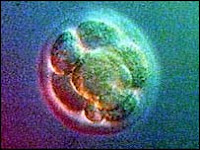
Hybrid embryo15:30 Breaking News: As expected, the Human Fertilisation and Embryology Authority has given the go-ahead for the creation of human-animal embryos for research. The Government's U-turn follows an HFEA consultation that apparently showed the public were "at ease" with the idea when told it could pave the way for therapies for conditions such as Alzheimer's disease.

Which rather begs the question, as well as being told about some of the theoretical possible benefits, were the public also told about the even more probable risks? For, contrary to the impression given by some of those who argue in favour of creating human-nonhuman cybrids (cytoplasmic hybrids), some of the most relevant questions relating to the ethical discussion arise not from a consideration of human dignity or any religious grounds but rather from a scientific perspective and the actual possible usefulness of these entities.

In this regard, a report by BioCentre, The New Inter-Species Future?, made the following points:

1. Experiment needs confirming

The scientific merit and validity of experiments already undertaken (involving cow-human and rabbit-human hybrid embryos) remain to be confirmed by an independent research group repeating the procedures.

2. Interspecies mitochondrial-nuclear DNA dysfunction

The medical risks of implanting cells that contain a combination of animal and human mitochondrial DNA and human nuclear DNA are considerable, given that there are varying degrees of interspecies incompatibility between mitochondrial and nuclear functions. Furthermore, it should be noted that mitochondrial dysfunction has been discovered to be a key factor in many neurodegenerative diseases such as Alzheimer's and Parkinson's diseases. Since many of the diseases claimed to be treatable by therapeutic cloning are neurodegenerative, using stem cells from human-nonhuman cybrids would be liable to result in profound medical risks. Similarly, the use of such stem cells to treat heart or liver complaints could create a number of difficulties owing to the high level of mitochondrial activity in these organs.

3. Difficulty in interpreting results

Regarding the use of human-nonhuman cybrids for research into diseases, there are so many profound genetic and epigenetic flaws in cloned embryos (even using eggs of the same species), that to use embryos created by interspecies nuclear transfer would be liable to become a study of artefacts. In other words, it would be difficult to interpret the results. The potential of an experiment, to add to the sum of knowledge is only as good as its capacity for interpretation.

4. Risk of creating new diseases

There would also be risks of transmission of animal diseases to humans or the creation of new diseases if any of the cybrid embryos were implanted into a host or not kept in a bio-secure environment.

5. Immunological incompatibility

Finally, it should be noted that it is doubtful whether the cells arising from human-nonhuman cybrids, in which an animal egg is used would become more human with development from the perspective of immunological compatibility and could ever have clinical applications. Because of this, and other factors, it is extremely unlikely that they would be used for transplantation in human patients.

19 June 2007

Undignifying Research?

Genetic research on human-animal chimerasThe Independent reports that Britain's top scientists are calling on the Government to lift a ban on the use of embryos created from human eggs and animal sperm.

In actual fact, the Academy of Medical Sciences report, Inter-species embryos, does not go as far as making any such explicit call. It simply notes, "The reasons for banning the creation of hybrid embryos for in vitro experimental use, while permitting research involving other types of human embryo incorporating animal material, are not clear to us, but we are not aware of any current scientific reasons to create such entities," adding elsewhere, "However, given the speed of this field of research, the emergence of scientifically valid reasons in the future cannot be ruled out."

Somewhat ironically, though, in making their case for proceeding with research on other kinds of hybrid and chimeric embryos, they use an argument that could equally undermine respect afforded to people who are disabled or elderly. For they argue that human "dignity arises from the qualities possessed by a creature, rather than species membership per se." Explaining their point in more detail, they state:

"We judge it unlikely that ‘human dignity’, a phrase used to emphasise the special moral status and importance of human beings, derives simply from species membership. If the concept of ‘human dignity’ has content, it is because there are factors of form, function or behaviour that confer such dignity or command respect. Either hybrid creatures would also possess these factors or they would not. If they do possess these factors, they would also have a specific type of dignity analogous or identical to human dignity that other creatures lack; if not, they would not."
However, they do not define what these mystic "factors of form, function or behaviour" are. If we can justify excluding human rights from individuals who because of their immaturity lack certain undefined "factors of form, function or behaviour," then what is to prevent us from excluding those same rights from individuals who because of physical or mental impairment also lack those same factors?

Conversely, if human rights are rightly extended to the physically disabled, the mentally impaired, and individuals in a persistent vegetative state, and if "human" rights are even to be extended to great apes and robots, on the basis of "the qualities possessed by a creature" though they do not even share "species membership" with us, then how can we justify excluding those same rights from individuals who because of their immaturity lack certain undefined "factors of form, function or behaviour"? Or, to encroach on the abortion debate, at what point of maturity do embryos acquire the necessary "factors of form, function or behaviour" to merit their protection from needless destruction? At present, the creation and use of human embryos for research is not permitted beyond 14 days in vitro. In order to be consistent, should the time frame allowed for human embryo research be extended to 24 weeks to match that for abortions, should the time frame for abortions be reduced to 14 days to match that for in vitro experiments, or should some other compromise be reached?

17 May 2007

Chimera Ban Lifted

As widely expected, the Government has caved in to pressure over its proposed chimera research ban and will now permit the creation of "inter-species entities"—that is, human-animal hybrid embryos—for research.

Regulars of this blog will be familiar with fears that Britain's apparent dismissal of a number of international ethical agreements means we increasingly risk becoming known as an ethical rogue state. It will be interesting to see what feedback we receive from international sources over this latest draft Human Tissue and Embryos Bill.

The changes also remove a baby's right to a father, affording single women and lesbian couples in a civil partnership with the same "human rights" as married women, meaning that it will be easier for them to receive IVF treatment.

Afternoon UPDATE: Here's the first of the American commentary on today's Government U-turn: The Island Of Dr. Moreau, which asks "What happened to all of the European concern over genetic purity?"—a good question, in view of the European Parliament's decision at the end of last month to adopt new rules authorising so-called "advanced therapies" (adult stem-cell therapy, gene therapy, and tissue engineering) despite "considerable misgivings from some MEPs over ethical questions," principally from members in Eastern Europe, Italy and Germany, who warned "If Europe rightly wants to set human rights standards in the world, it can not afford to adopt a 'passive position' when it comes to advanced therapies."

05 April 2007

Damaging UK Science

BBC: Hybrid embryo ban 'unnecessary'In the debate over the creation of human-animal hybrid embryos, the Commons Science and Technology Select Committee has come down on the side of the 223 medical charities and patient groups who have petitioned the government to sanction the research, suggesting that any ban could potentially harm UK science.

Earlier in the year, the think tank Demos claimed that Britain risks being sidelined in the global science revolution and suggested that "Britain should promote itself as a cosmopolitan centre: open and willing to support the best ideas and the most innovative talent from across the world." However, we need to make a distinction between being cosmopolitan and being liberal. For, in seeking to reinvent ourselves for the new age of globalisation, we risk losing another strength for which we used to be known. As I wrote a month ago, where our reputation used to be as a moral leader, our apparent dismissal of a number of international ethical agreements means we are increasingly becoming known as an ethical rogue state.

Demos was right that Britain is "sleepwalking out of its special relationship" with many countries, not just for the reason they suggest – our failure to invest and engage in collaborative research – but also because not enough people have woken up to how fast other countries are developing and too few are even aware that our legislation lags a decade behind our global competitors. If Britain is not to be left behind completely and become a marginal science and innovation player in world terms, we must stop being ashamed of what once made Britain Great and must rediscover the moral foundation that helped establish this nation as a world leader.

UPDATE: Want to know who else is dabbling in chimeras? Iranian professor Esmail Zanjani from the University of Nevada has just created the world's first human-sheep! For some of the possible unexpected consequences, see this New Scientist report into human-pig chimeras from three years ago.

01 March 2007

Chimera Research Ban

Listening to Sir David King, the government's chief science adviser, speaking before the Commons Science and Technology Committee yesterday on the Government's proposed ban against the creation of human-animal chimeras, you could be forgiven for thinking that New Labour was becoming the Neo-Luddite party.

The Wellcome Trust on the UN declarationIn truth, however, the Government is out of step with the rest of the Western democratic world and appears to have turned a blind eye to the 2005 United Nations Declaration on Human Cloning, which called on all nations "to adopt all measures necessary to prohibit all forms of human cloning inasmuch as they are incompatible with human dignity and the protection of human life." The UK is also the only state besides Belgium among the 46 countries of Europe that still refuses to ratify the 1997 European Convention on Human Rights and Biomedicine, which further means we remain unable to sign successive agreements, such as that prohibiting human cloning.

Tuesday's Times reported that ministers are going to drop their intended legislation for fear it might damage British science. In fact, any ban might actually begin to restore international credibility to British science, for we have long surrendered the moral high ground and risk being seen as an "ethical rogue state".