Showing posts with label ethics. Show all posts

27 January 2008

Labour's Ethical Rebels

In the latest tussle over the government's controversial Human Fertilisation and Embryology Bill, that would allow the creation of human-animal hybrid embryos and allow children to be born by IVF without a father's involvement, the Observer reports that senior Labour Catholics are demanding a free vote when the bill returns to the Commons after Easter, claiming that the ethical issues it raises are matters of conscience. Among the those wanting to be led by their consciences rather than blindly following the party line are Transport Secretary Ruth Kelly, Welsh Secretary Paul Murphy, and Defence Secretary Des Browne. Others apparently include a Northern Ireland Office minister and three Labour whips.

Even though our party machines do not like their members to think freely, on this issue perhaps more than any other under current debate, it would surely be right for our elected representatives to be allowed to stand up and be counted for their own personal beliefs.

24 January 2008

Beyond Consent

At a time when an “opt-out” system for organ donation is attracting strong opposition, it is extraordinary that deriving a clone or other embryo from a non-consenting child or older patient should be seen as acceptable ethically. There is a big difference between authorising research on one’s own cells alone, as with standard adult stem-cell research, and authorising the creation and destruction of human embryos or hybrid human entitites. Consent for the latter, highly controversial practices should never be presumed.
On Monday, a group of scientists wrote a letter in The Times objecting to a proposed ban on the generation of embryos in stem cell research using cells for which the donors did not, or could not, give specific consent. Today the paper publishes an excellent group response, picking up on some of the same ethical issues this blog highlighted earlier this month on the possible use of stem-cells from non-consenting adults and children.

Read the whole letter at Times Online.

12 September 2007

Ethics Code For Politicians

Professor Sir David King [BBC]Professor Sir David King has outlined seven principles aimed at building trust between scientists and society: Rigour, respect and responsibility: a universal ethical code for scientists. How about a similar code for politicians, in addition to the existing ministers' code of conduct, to help rebuild trust between politicians and society? Here's a first draft for you to suggest improvements to, based on the proposed code for scientists:

Rigour, honesty and integrity

  • Act with skill and care in all political activities. Maintain up to date skills and assist their development in others
  • Take steps to prevent corrupt practices and professional misconduct. Declare conflicts of interest
  • Be alert to the ways in which your own political activities derives from and affects the work of other people, and respect the rights and reputations of others
Respect for life, the law and the public good
  • Ensure that your work is lawful and justified
  • Minimise and justify any adverse effect your political activities may have on people, animals and the natural environment
Responsible communication: listening and informing
  • Seek to discuss the issues that politics raises for society. Listen to the aspirations and concerns of others
  • Do not knowingly mislead, or allow others to be misled, about political matters. Present and review political evidence, theory or interpretation honestly and accurately

11 September 2007

Ethical Business Pioneer Roddick

Dame AnitaI don't usually do obituaries or tributes, but since a precedent was set (Lord Deedes) while the reins for this blog were handed over during my recent Venetian break, I thought I would reproduce a Church Times interview of relevance to this blog's themes with Body Shop founder and Fair Trade supporter, Dame Anita Roddick, who died yesterday aged 64 after a major brain haemorrhage. I particularly commend the final two paragraphs to you:

Speaking to the Church Times, ahead of coming to the Festival in 2004 for the second year running, Dame Anita said: “What’s wonderful about being my age is having to face your prejudices."

And she continued: "I had no idea how big Greenbelt was. I had no idea how organised it was; how free it was; how joyful it was. And I had no idea that there was such a strong activist, trade justice plank in its platform."

“It’s really hard, when you have had your antennae up for most of these movements, to have completely ignored it. I have fallen for the zeitgeist that says anybody who has a religious inclination has no sense of rationale or intellectual understanding and therefore should be dismissed."

“I am cheering the Greenbelt festival from the top of every bloody mountain…for me, it’s like a heartbeat. And it’s youth. I’m ashamed of my bloody prejudices, but I’m delighted to be a convert. I find it wonderful.”
Source: Greenbelt Festivals

05 September 2007

Possible Usefulness of Cybrid Embryos

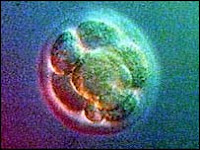
Hybrid embryo15:30 Breaking News: As expected, the Human Fertilisation and Embryology Authority has given the go-ahead for the creation of human-animal embryos for research. The Government's U-turn follows an HFEA consultation that apparently showed the public were "at ease" with the idea when told it could pave the way for therapies for conditions such as Alzheimer's disease.

Which rather begs the question, as well as being told about some of the theoretical possible benefits, were the public also told about the even more probable risks? For, contrary to the impression given by some of those who argue in favour of creating human-nonhuman cybrids (cytoplasmic hybrids), some of the most relevant questions relating to the ethical discussion arise not from a consideration of human dignity or any religious grounds but rather from a scientific perspective and the actual possible usefulness of these entities.

In this regard, a report by BioCentre, The New Inter-Species Future?, made the following points:

1. Experiment needs confirming

The scientific merit and validity of experiments already undertaken (involving cow-human and rabbit-human hybrid embryos) remain to be confirmed by an independent research group repeating the procedures.

2. Interspecies mitochondrial-nuclear DNA dysfunction

The medical risks of implanting cells that contain a combination of animal and human mitochondrial DNA and human nuclear DNA are considerable, given that there are varying degrees of interspecies incompatibility between mitochondrial and nuclear functions. Furthermore, it should be noted that mitochondrial dysfunction has been discovered to be a key factor in many neurodegenerative diseases such as Alzheimer's and Parkinson's diseases. Since many of the diseases claimed to be treatable by therapeutic cloning are neurodegenerative, using stem cells from human-nonhuman cybrids would be liable to result in profound medical risks. Similarly, the use of such stem cells to treat heart or liver complaints could create a number of difficulties owing to the high level of mitochondrial activity in these organs.

3. Difficulty in interpreting results

Regarding the use of human-nonhuman cybrids for research into diseases, there are so many profound genetic and epigenetic flaws in cloned embryos (even using eggs of the same species), that to use embryos created by interspecies nuclear transfer would be liable to become a study of artefacts. In other words, it would be difficult to interpret the results. The potential of an experiment, to add to the sum of knowledge is only as good as its capacity for interpretation.

4. Risk of creating new diseases

There would also be risks of transmission of animal diseases to humans or the creation of new diseases if any of the cybrid embryos were implanted into a host or not kept in a bio-secure environment.

5. Immunological incompatibility

Finally, it should be noted that it is doubtful whether the cells arising from human-nonhuman cybrids, in which an animal egg is used would become more human with development from the perspective of immunological compatibility and could ever have clinical applications. Because of this, and other factors, it is extremely unlikely that they would be used for transplantation in human patients.

19 June 2007

Undignifying Research?

Genetic research on human-animal chimerasThe Independent reports that Britain's top scientists are calling on the Government to lift a ban on the use of embryos created from human eggs and animal sperm.

In actual fact, the Academy of Medical Sciences report, Inter-species embryos, does not go as far as making any such explicit call. It simply notes, "The reasons for banning the creation of hybrid embryos for in vitro experimental use, while permitting research involving other types of human embryo incorporating animal material, are not clear to us, but we are not aware of any current scientific reasons to create such entities," adding elsewhere, "However, given the speed of this field of research, the emergence of scientifically valid reasons in the future cannot be ruled out."

Somewhat ironically, though, in making their case for proceeding with research on other kinds of hybrid and chimeric embryos, they use an argument that could equally undermine respect afforded to people who are disabled or elderly. For they argue that human "dignity arises from the qualities possessed by a creature, rather than species membership per se." Explaining their point in more detail, they state:

"We judge it unlikely that ‘human dignity’, a phrase used to emphasise the special moral status and importance of human beings, derives simply from species membership. If the concept of ‘human dignity’ has content, it is because there are factors of form, function or behaviour that confer such dignity or command respect. Either hybrid creatures would also possess these factors or they would not. If they do possess these factors, they would also have a specific type of dignity analogous or identical to human dignity that other creatures lack; if not, they would not."
However, they do not define what these mystic "factors of form, function or behaviour" are. If we can justify excluding human rights from individuals who because of their immaturity lack certain undefined "factors of form, function or behaviour," then what is to prevent us from excluding those same rights from individuals who because of physical or mental impairment also lack those same factors?

Conversely, if human rights are rightly extended to the physically disabled, the mentally impaired, and individuals in a persistent vegetative state, and if "human" rights are even to be extended to great apes and robots, on the basis of "the qualities possessed by a creature" though they do not even share "species membership" with us, then how can we justify excluding those same rights from individuals who because of their immaturity lack certain undefined "factors of form, function or behaviour"? Or, to encroach on the abortion debate, at what point of maturity do embryos acquire the necessary "factors of form, function or behaviour" to merit their protection from needless destruction? At present, the creation and use of human embryos for research is not permitted beyond 14 days in vitro. In order to be consistent, should the time frame allowed for human embryo research be extended to 24 weeks to match that for abortions, should the time frame for abortions be reduced to 14 days to match that for in vitro experiments, or should some other compromise be reached?

15 June 2007

Ethical Science

It's not every day that I agree with something Peter Mandelson, the EU Trade Commissioner, says. So, his defence of what he calls "The coal face of applied science in the twenty first century," biotechnology, is worth quoting from quite extensively:

"We need an open and rational debate about the risks and benefits of biotechnology more than ever."

"We are already living in a biotech era – from the medicine you take to the laundry detergent you use. ... The most recent Eurobarometer on this subject from 2005 actually showed that most Europeans are enthusiastic about potential new applications of biotechnology. But there is one glaring exception. Something like six in ten Europeans say they oppose Genetically Modified food."

"It is reasonable to insist that when the process [of thoroughly testing all new biotech products to the most rigorous scientific standards] has run its course, and the scientific issues have been thrashed out, we stand by the science. And that applies to both the technical experts and to the politicians they report to. A rigorous system means approving GM imports when the science is on their side just as we take a firm line when precaution is justified. ... If politicians and risk managers undermine their own system... we devalue objective science as our most important benchmark - and that is a dangerous step to take."

"We must be under no illusion that Europe's interests are served by being outside a global market that is steadily working its way through the issues raised by GM food. They are not."

"The biotech industry needs to keep in mind that while technology determines what is possible, consumer demand determines what is economically viable. Public fears may be misplaced, but they cannot and should not be dismissed."

"The way that human technologies affect us and the natural world has always been a flashpoint for debate. Biotechnology is no different. The only rational response is a patient assessment of the evidence and a careful explanation of the facts. Biotechnology has already improved millions of lives around the world. That alone is reason enough to ensure that we do not deny those benefits to millions more."
The only point that I would add is he makes no mention of ethics. If the public believe there are ethical questions to answer, even if the scientists and politicians do not, then the "open and rational debate" and "careful explanation of the facts" needs to address those fears also.

05 June 2007

Virtual Victims & Cyber-Crime

Second LifeI don't know if any of you have ever visited Second Life, the parallel universe in virtual reality—I certainly haven't. However, Nigel Cameron has a fascinating post on his blog, ChoosingTomorrow, highlighting how the distinction between what is real and what is unreal is not as clear as some of us who are not "plugged in" to any other cyber-dimensions might believe. For, police in this universe of ours are seriously investigating alleged crimes of virtual rape and virtual child abuse in cyberspace.
Perhaps the world of avatars needs to establish its own laws and criminal justice systems?

01 June 2007

Big Brother Hoax

BREAKING NEWS: The Dutch kidney transplant reality show was a hoax!

Dutch kidney transplant reality show was a hoax

A Dutch reality television show in which a supposedly dying woman had to pick one of three contestants to whom she would donate a kidney was a hoax, the programme makers said on Friday.

The show, produced by the public broadcaster BNN, was condemned by Prime Minister Jan Peter Balkenende of the Netherlands ahead of transmission and sparked controversy worldwide.

Identified only as "Lisa," the 37-year-old woman who had been said to have a brain tumor, was to base her selection on the person's history and conversations with the candidates' families and friends.

At the last minute, she was revealed as a healthy actress. The contestants were also part of the deception.
BNN said it wanted to draw attention to the growing shortage of organ donors in the Netherlands.

29 May 2007

Reality TV: Get A Life

I suppose that I have never understood the voyeuristic urges that have so popularised reality TV shows. However, the latest such show from Holland truly seems like something out of science fiction - somehow reminiscent of Schwarzenegger's Running Man, where lives of contestants are involved. For Dutch viewers will be phoning in to vote for which of three patients will receive the donated kidney from a terminally ill lady called Lisa.

Making money out of the televised modern equivalents of beauty and popularity contests is one thing. Doing the same to resolve ethical questions of medical need seems like a dangerous first step towards the legal sale of body parts.

17 May 2007

Chimera Ban Lifted

As widely expected, the Government has caved in to pressure over its proposed chimera research ban and will now permit the creation of "inter-species entities"—that is, human-animal hybrid embryos—for research.

Regulars of this blog will be familiar with fears that Britain's apparent dismissal of a number of international ethical agreements means we increasingly risk becoming known as an ethical rogue state. It will be interesting to see what feedback we receive from international sources over this latest draft Human Tissue and Embryos Bill.

The changes also remove a baby's right to a father, affording single women and lesbian couples in a civil partnership with the same "human rights" as married women, meaning that it will be easier for them to receive IVF treatment.

Afternoon UPDATE: Here's the first of the American commentary on today's Government U-turn: The Island Of Dr. Moreau, which asks "What happened to all of the European concern over genetic purity?"—a good question, in view of the European Parliament's decision at the end of last month to adopt new rules authorising so-called "advanced therapies" (adult stem-cell therapy, gene therapy, and tissue engineering) despite "considerable misgivings from some MEPs over ethical questions," principally from members in Eastern Europe, Italy and Germany, who warned "If Europe rightly wants to set human rights standards in the world, it can not afford to adopt a 'passive position' when it comes to advanced therapies."

18 April 2007

Terminator: Rise of the Machines

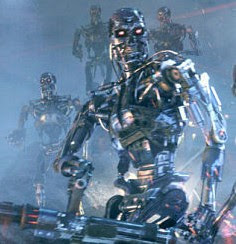
TerminatorThe American Army already deploys robot soldiers in Iraq. Equipped with tank tracks and automatic weapons, these robotic units, known as SWORDS (Special Weapons Observation Reconnaissance Detection Systems), allow humans to attack the enemy by remote control.
Last week an engineer at the Naval Surface Warfare Centre, an American weapons-research and test establishment, published a set of laws to govern operations by killer robots. Citing the precedent set by the Tomahawk Anti-Ship Missile, CAPTOR Mine, Aegis Ships, automatic Cruise missile defense, and Patriot automated air defense, John Canning made the following proposals:

  • Let the machines target other machines
    • Specifically, let’s design our armed unmanned systems to automatically ID, target, and neutralize or destroy the weapons used by our enemies –not the people using the weapons.
    • This gives us the possibility of disarming a threat force without the need for killing them.
    • We can equip our machines with non-lethal technologies for the purpose of convincing the enemy to abandon their weapons prior to our machines destroying the weapons, and lethal weapons to kill their weapons.
  • Let men target men
    • In those instances where we find it necessary to target the human (i.e. to disable the command structure), the armed unmanned systems can be remotely controllable by human operators who are “in-the-weapons-control-loop”
  • Provide a “Dial-a-Level” of autonomy to switch from one to the other mode.
Canning quotes a legal specialist as saying, "We can target objects when they are military objectives and we can target people when they are military objectives. If people or property isn't a military objective, we don't target it. It might be destroyed as collateral damage, but we don't target it. Thus in many situations, we could target the individual holding the gun and/or the gun and legally there's no difference."

Now, The Economist reports on the research of Ronald Arkin of the Georgia Institute of Technology, who is generating an artificial conscience for battlefield robots to ensure that their use of lethal force follows the rules of ethics, based on existing ethical decision-making protocols (e.g. the Geneva Convention), rules of engagement, and other ethical and military requirements.

Incidentally, for anyone feeling a little lonely, Mr Arkin is also working on behavioural development for a humanoid robot "with the long-term goal of providing highly satisfying long-term interaction and attachment formation by a human partner."  Hardly bears thinking about, does it...?!

So much for Isaac Asimov's three laws of robotics!

09 April 2007

Our Ethical Heritage

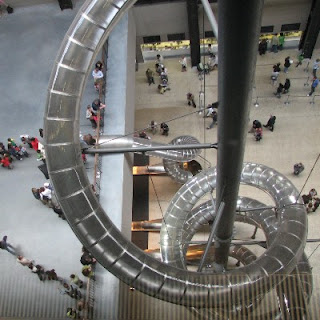
Carsten Höller's 'Test Site'In belated celebration of my birthday (yes, it was a Good Friday, thank you), I today took the family to London, principally in order that my six-year-old, who recently studied the great fire of London at school, could visit the Monument. We also popped into Tate Modern while at St Paul's Cathedral, but didn't think much of anything that goes by the name of art in that building, with the exception of Höller's Test Site, though that's really just an oversized children's slide – the sun dial opposite the Tower of London was a far more interesting sculpture.

All that to say, I'm late getting to the papers today, but Bruce Anderson in The Independent makes for an edifying read this Easter Monday, expanding on the comments made by the Archbishop of Birmingham a couple of days ago:

In the West, we have a vast cultural and intellectual heritage. But our ethical heritage is sadly depleted. Its two wells were the Classics and Christianity. The Classical well has already ceased to function. The Christian one may run dry even before the oil wells.
He concludes, "In our dealings with Islam, it would help us if we had more confidence in our own values and traditions. In order for that to occur, as many people as possible ought to believe in the Resurrection of Jesus Christ."  Given that I can imagine a number of people dismissively throwing their hands up at that suggestion, a good start at least would be for as many people as possible to understand the contribution that Christianity has made to Western culture ... a possible topic for one of our experts to address in a future edition of The Difference, perhaps?

(Yes, I did experience Carsten Höller's "voluptuous panic upon an otherwise lucid mind" – "unexpectedly bumpy" was the verdict.)

05 April 2007

Damaging UK Science

BBC: Hybrid embryo ban 'unnecessary'In the debate over the creation of human-animal hybrid embryos, the Commons Science and Technology Select Committee has come down on the side of the 223 medical charities and patient groups who have petitioned the government to sanction the research, suggesting that any ban could potentially harm UK science.

Earlier in the year, the think tank Demos claimed that Britain risks being sidelined in the global science revolution and suggested that "Britain should promote itself as a cosmopolitan centre: open and willing to support the best ideas and the most innovative talent from across the world." However, we need to make a distinction between being cosmopolitan and being liberal. For, in seeking to reinvent ourselves for the new age of globalisation, we risk losing another strength for which we used to be known. As I wrote a month ago, where our reputation used to be as a moral leader, our apparent dismissal of a number of international ethical agreements means we are increasingly becoming known as an ethical rogue state.

Demos was right that Britain is "sleepwalking out of its special relationship" with many countries, not just for the reason they suggest – our failure to invest and engage in collaborative research – but also because not enough people have woken up to how fast other countries are developing and too few are even aware that our legislation lags a decade behind our global competitors. If Britain is not to be left behind completely and become a marginal science and innovation player in world terms, we must stop being ashamed of what once made Britain Great and must rediscover the moral foundation that helped establish this nation as a world leader.

UPDATE: Want to know who else is dabbling in chimeras? Iranian professor Esmail Zanjani from the University of Nevada has just created the world's first human-sheep! For some of the possible unexpected consequences, see this New Scientist report into human-pig chimeras from three years ago.

29 March 2007

Non-Human Rights?

According to the BBC, an international movement is apparently gathering pace to give apes the same rights as humans. This follows the news earlier this month that South Korea is developing an ethical code to prevent humans abusing robots, and vice versa. The draft of a similar set of guidelines being drawn up by the European Robotics Research Network and to be released next month begins, "In the 21st Century humanity will coexist with the first alien intelligence we have ever come into contact with - robots."

Is science really equipped to deal with questions of morality? I thought not.

ISAAC ASIMOV'S LAWS OF ROBOTICS

I, Robot
  1. A robot may not injure a human being or, through inaction, allow a human being to come to harm.
  2. A robot must obey orders given it by human beings except where such orders would conflict with the First Law.
  3. A robot must protect its own existence as long as such protection does not conflict with the First or Second Law.
EVENING UPDATE: You can find the details at the Institute for Ethics and Emerging Technologies, whose report starts, "Beginning a movement that may propel Spain as a leader in animal welfare, the Balearic Parliament has recently announced its approval of a resolution to grant legal rights to great apes."

22 March 2007

Moral Maze

A runaway trolley is heading down the tracks toward five workmen who will be killed if the trolley proceeds on its present course. You are on a footbridge over the tracks, in between the approaching trolley and the five workmen. Next to you on this footbridge is a stranger who happens to be very large. The only way to save the lives of the five workmen is to push this stranger off the bridge and onto the tracks below where his large body will stop the trolley. The stranger will die if you do this, but the five workmen will be saved. Would you push the stranger on to the tracks in order to save the five workmen?

Researchers at the University of Southern California in Los Angeles have been exploring the role of emotion in moral decisions and have discovered that while most people reject solutions to dilemmas that involve harming one person to save others, people with damage to an area of the brain just behind the forehead endorse such decisions.

Nature reports:

"Social emotions were really the scaffolding for what we came to construct as ethics. How those social emotions are taken into account in the process of decision-making seems to be very biological. When things get complicated, we engage an emotional system - it's not reason alone."
More moral dilemmas used in the research can be found in the report.

18 February 2007

Tony Blair's Minority Report

Last Wednesday I noticed a Scientific American report on neuroethics. It began:

"Neuroscientists are making such rapid progress in unlocking the brain's secrets that some are urging colleagues to debate the ethics of their work before it can be misused by governments, lawyers or advertisers.
"The news that brain scanners can now read a person's intentions before they are expressed or acted upon has given a new boost to the fledgling field of neuroethics that hopes to help researchers separate good uses of their work from bad."

When I heard Tony Blair discussing gun crime and the UNICEF report with Andrew Marr on Sunday AM this morning, I realised that the neuroscientists are probably right to fear. His words reminded me of statements the PM made last summer that he believes we need to predict and intervene far more early in the lives of those who are going to become a menace to society, "pre-birth even". In case you missed it, this is what he said today: "My view increasingly is that if you analyse this problem it is a problem of families who need to be put in, with very early intervention, in a structured framework where you are making sure that the children in those situations get looked after from a very, very early age."

As Nigel Cameron says on his blog: The movie Minority Report keeps tugging at today from tomorrow.