Showing posts with label science. Show all posts

26 January 2008

Climate Science Is Settled

Certain authorities keep trying to convince us that the science of climate change is settled. So why is it that climate scientists continue to reach opposing conclusions?

You may remember research from last spring indicating that increases in vertical wind sheer – differences between the upper and lower levels of the atmosphere in wind direction and speed – could counter-balance the effects of warming waters. Although conventional wisdom suggests that global warming could result in more powerful storms, examination of 150 years of hurricane records in fact reveals a small decline in hurricanes making landfall in the United States as oceans warmed. This latest inconvenient observation apparently triggered "lively debate" at the annual meeting of the American Meteorological Society.

Little wonder the majority of people remain sceptical† about the severity of claims made by politicians and the media!

† A global survey conducted last year concluded that just one in five believe human causes are the main factors driving climate change.

22 December 2007

Global Warming Fears Cooling?

"Many scientists from around the world have dubbed 2007 as the year man-made global warming fears “bite the dust”"

"Looks like man-made global warming theory is melting away faster than you can say Al Gore. A lot of reputations are now going to disappear along with it: all those who were part of the famous ‘consensus’ (not). Those people should never be taken seriously again.

It’s over, guys. Reason, truth and real science are fighting back."
Ouch! Don't miss Melanie Phillips in the Spectator, where she quotes geophysicist David Denning and a US Senate report, for all the details. She also quotes the New Statesman, which observes:
For the past decade the world has not warmed. Global warming has stopped. It’s not a viewpoint or a sceptic’s inaccuracy. It’s an observational fact…. So we are led to the conclusion that either the hypothesis of carbon dioxide induced global warming holds but its effects are being modified in what seems to be an improbable though not impossible way, or, and this really is heresy according to some, the working hypothesis does not stand the test of data.
Well worth a read, even if you disagree — perhaps, especially if you disagree.

18 December 2007

DNA Programmers & Bio Hackers

"We're heading into an era where people will be writing DNA programs like the early days of computer programming, but who will own these programs?"

Today a scientist can write a long genetic program on a computer just as a maestro might compose a musical score, then use a synthesizer to convert that digital code into actual DNA. Experiments with "natural" DNA indicate that when a faux chromosome gets plopped into a cell, it will be able to direct the destruction of the cell's old DNA and become its new "brain" -- telling the cell to start making a valuable chemical, for example, or a medicine or a toxin, or a bio-based gasoline substitute.
By this time next year, the first living cells with fully artificial genomes could be growing.

So, which do you think legislators should most fear, bio-terror or bio-error? Check the Washington Post for more details on the status of mankind's creation of artificial life.

04 December 2007

Time To Emigrate?

Last week we learnt the extent to which this Government has failed our primary school pupils, the reading performance of our ten-year-olds having fallen from third to fifteenth place in the world in just five years. Today we are further informed that an equally disasterous slump in performance is evident in our secondary schools, with the UK dropping out of the top-performing group of countries for reading and maths standards. Seven years ago, the UK ranked eighth in maths and seventh in reading in the Programme for International Student Assessment (PISA) league tables; today, we sit at an appallingly average 24th place for maths and 17th for literacy. For school science, using a system which places countries within a range of rankings, we have slipped from fourth place to between 12th and 18th place.

Launching the report, the OECD Secretary-General Angel Gurría stressed the importance of education for the development of people and society: "Effective and innovative education policies open enormous opportunities for individuals. They also underpin healthy and vibrant economies." Quite. Conversely, chanting the mantra "Education, education, education," will no more equip the next generation than invoking the incantation "Abracadabra."

26 November 2007

GM Crop Results Scandal

What are politicians to do when scientific studies undermine their political stances? One option would be to admit their previous judgement was mistaken. Another is to cover up the studies...

Just a month since France ran into trouble with the European Commission over its proposed freeze on the planting of genetically modified crops, we now learn that government officials in Italy have for two years been suppressing the results of field trials on a genetically engineered strain of maize showing that compared with conventional varieties, the GM crop has both a higher yield (by 28-43%) and significantly lower levels of toxins (less than 1% the fumonisin content, which appears to cause neural tube birth defects such as spina bifida).

As Peter Mandelson noted earlier this year, "We need an open and rational debate about the risks and benefits of biotechnology more than ever... We must be under no illusion that Europe's interests are served by being outside a global market that is steadily working its way through the issues raised by GM food. They are not."

UPDATE: Interesting to see the IHT is reporting that the European agriculture commissioner, Mariann Fischer Boel, has today warned farm ministers that resistance in Europe to imports of genetically modified products is contributing to the rising cost of raising pigs and chickens, and could pose a threat to the meat industry.

For further details, see Truth About Trade & Technology

17 November 2007

Dolly Scientist's U-Turn

The Government must be kicking itself. Just two months after the Human Fertilisation and Embryology Authority gave its go-ahead for the creation of human-animal embryos for research, Professor Ian Wilmut, the leading scientist who controversially created Dolly the sheep, is abandoning the cloning of human embryos in favour of a rival method developed in Japan that he says has greater potential for stem cell research than the use of embryonic cells.

If only the politicians had heeded the scientific advice they were given at the time detailing questions over the actual possible usefulness of these entities and the lack of evidence for any current scientific reasons to create them.

16 November 2007

The End Is Nigh

At last, the UN has agreed its fourth and final report on climate change — or, more accurately, its final "synthesis" of the report from the highly politicised Intergovernmental Panel on Climate Change. The twenty-page document, to be released tomorrow in Valencia by UN Secretary General Ban Ki-moon, is intended to act as a blueprint for the next round of climate talks starting next month in Bali, Indonesia, as the world's governments negotiate a successor to the Kyoto treaty, which expires in 2012.

Despite offering no new scientific evidence for human-caused global warming, and despite reducing their earlier predictions for future warming and suggesting its impact will be less severe and more distant than they had previously claimed, this latest forecast makes the strongest assertions yet that mankind is pushing the climate past some irreversible tipping point, some "point of no return."

As regular readers will know, I'm all for a serious discussion about environmental and social sustainability. I just wish the debate could be a little less myopic and a little more open, a little less hysterical and a little more rational.

29 October 2007

GM Growth Challenge

GM maize cultivation in the EU [Source: BBC]Last week the European Commission warned President Nicolas Sarkozy that a proposed temporary freeze on the planting of genetically modified crops in France contravenes European law and today we learn that the area planted with such crops in Europe increased by 77% last year, giving the biotech industry cause to claim this proves their product is appealing to farmers and safe for the environment.

In the current issue of The Difference, retired animal geneticist John Hodges asks what risk cloned meat and milk might present to consumers, expresses fears that unknown abnormalities may be transferable to humans through food as happened with Mad Cow Disease (BSE) and variant Creutzfeldt Jakob Disease (vCJD), and calls upon the UK and the EU parliaments to take an independent position on cloned-animal products for human consumption:

"The decision not to label is contrary to the economic principle that markets work effectively when decisions are made by customers with access to full information – “the customer is right”. This whole scenario is unethical and has the flavour of vested business interests successfully pressuring government quickly to approve their desired objective. One suspects they know that hypothetical polls have already shown consumer resistance. Further, the limited tests do not offer authentic scientific guarantees of food safety for a novel technique whose long-term hazards upon the whole population are unknown. Normal ethical standards for such an important issue cry out for public debate, for legislative rather than delegated executive action, for science relevant to the risk and for consumers’ rights and wishes to be respected. The issues are too important to be left to the ideology of market forces alone."
Let us know what you think — and if you haven't seen Hodges' article, order your copy of The Difference today!

21 October 2007

What Brown Really Thinks

Just back from a very relaxing weekend in Hampshire's sun. Three thoughts briefly tempted me to blog but, as you'll have noticed, I resisted. The first and third, taken together, seem to reveal much about what our Scottish Premier thinks about this nation:

1. Yesterday's leader in the Telegraph, MPs must be held to their word on EU treaty:

The Prime Minister is just one man. There are another 645 Members of Parliament, and 637 of them were, like Mr Brown, elected on the basis of a promise that they would give voters the final say.

Those 637 MPs must now decide whether they are true parliamentarians. Are they simply a block vote, agents of one man’s will? Or are they independent legislators, acting in accordance with what they judge to be their constituents’ interests and wishes?
2. Simon Heffer's piece also in yesterday's Telegraph, We should listen to what Watson says, on the controversial comments from Nobel-winning geneticist Professor James Watson on intelligence and race:
But how boot-faced, wicked and totalitarian of the Science Museum to cancel a lecture Prof Watson was due to give there because of the "offensive" nature of this subject.

How, for pity's sake, will we know Prof Watson is wrong if he is banned from airing his claims and having them held up to scrutiny?

Doesn't the museum understand that it is in its way as ignorant as the academic authorities were 200 years ago, when they forbade the teaching of geology because it might provoke the "offensive" idea that the Creation had not been as scripted?

What if that ban had been maintained?

Why does the Left only believe in academic freedom when it suits their own bigotries?
3. The lack of enthusiasm or apparent inability of the Prime Minister to sing the national anthem at last night's Rugby World Cup final. So much for all that talk of Britishness, national pride, and patriotism. Yes, even I, sports unenthusiast that I am, watched the game!

10 October 2007

Convenient Untruths

Just last week, the envirocrats again attempted to flood the news airwaves with their apocalyptic message that the fabled opening of the Northwest Passage means the Arctic is melting at a disasterous rate and constitutes the latest catastrophic evidence of global warming — when, in truth, scientists told us earlier this year that the ice sheets are not losing their mass through melting but because the ice is flowing into the ocean faster than the snow is replacing it and that, without knowing why this is happening, it is impossible to predict the extent of future sea level rises, especially as climate modelling predicts that snowfall on the ice caps will increase over the coming century.

It was therefore a good day for science and education today when, despite Al Gore being tipped as the favourite to win the Nobel Peace Prize for his efforts on behalf of the climate change lobby [Can anyone seriously tell me he is in the same league as Burma's Aung San Suu Kyi?!], a High Court judge ruled in favour of Kent father Stewart Dimmock, who accused the Department of Children, Schools and Families of trying to "brainwash" children by sending thousands of copies of Gore's "shockumentary" An Inconvenient Truth to schools across the country. The judge concluded that the Oscar-winning film should only be distributed if it is accompanied by new guidlines explaining the numerous scientific errors contained in the former US vice-president's "one-sided" views — errors that he attributed to "alarmism and exaggeration."

As has previously been commented on this blog, if the Government were to send the failed presidential candidate's propaganda to every secondary school, then a copy of Martin Durkin's The Great Global Warming Swindle should also be sent, to encourage proper debate and help develop the next generation's critical thinking skills.

The Times lists the nine errors identified by the judge:

Error one

Al Gore: A sea-level rise of up to 20 feet would be caused by melting
of either West Antarctica or Greenland “in the near future”.

The judge’s finding: “This is distinctly alarmist and part of Mr
Gore’s ”wake-up call“. It was common ground that if Greenland melted it would
release this amount of water - “but only after, and over, millennia.”

Error two

Gore: Low-lying inhabited Pacific atolls are already “being inundated
because of anthropogenic global warming.”

Judge: There was no evidence of any evacuation having yet happened.

Error three

Gore: The documentary described global warming potentially “shutting
down the Ocean Conveyor” - the process by which the Gulf Stream is carried over
the North Atlantic to western Europe.

Judge: According to the Intergovernmental Panel on Climate Change
(IPCC), it was “very unlikely” it would be shut down, though it might slow down.

Error four

Gore: He asserted - by ridiculing the opposite view - that two graphs,
one plotting a rise in C02 and the other the rise in temperature over a period
of 650,000 years, showed “an exact fit”.

Judge: Although there was general scientific agreement that there was
a connection, “the two graphs do not establish what Mr Gore asserts”.

Error five

Gore: The disappearance of snow on Mt Kilimanjaro was expressly
attributable to global warming.

Judge: This “specifically impressed” David Miliband, the Environment
Secretary, but the scientific consensus was that it cannot be established that
the recession of snows on Mt Kilimanjaro is mainly attributable to human-induced
climate change.

Error six

Gore: The drying up of Lake Chad was used in the film as a prime
example of a catastrophic result of global warming, said the judge.

Judge: “It is generally accepted that the evidence remains
insufficient to establish such an attribution. It is apparently considered to be
far more likely to result from other factors, such as population increase and
over-grazing, and regional climate variability.”

Error seven

Gore: Hurricane Katrina and the consequent devastation in New Orleans
to global warming.

Judge: There is “insufficient evidence to show that”.

Error eight

Gore: Referred to a new scientific study showing that, for the first
time, polar bears were being found that had actually drowned “swimming long
distances - up to 60 miles - to find the ice”.

Judge: “The only scientific study that either side before me can find
is one which indicates that four polar bears have recently been found drowned
because of a storm." That was not to say there might not in future be
drowning-related deaths of bears if the trend of regression of pack ice
continued - “but it plainly does not support Mr Gore’s description”.

Error nine

Gore: Coral reefs all over the world were bleaching because of global
warming and other factors.

Judge: The IPCC had reported that, if temperatures were to rise by 1-3
degrees centigrade, there would be increased coral bleaching and mortality,
unless the coral could adapt. But separating the impacts of stresses due to
climate change from other stresses, such as over-fishing, and pollution was
difficult.

12 September 2007

Ethics Code For Politicians

Professor Sir David King [BBC]Professor Sir David King has outlined seven principles aimed at building trust between scientists and society: Rigour, respect and responsibility: a universal ethical code for scientists. How about a similar code for politicians, in addition to the existing ministers' code of conduct, to help rebuild trust between politicians and society? Here's a first draft for you to suggest improvements to, based on the proposed code for scientists:

Rigour, honesty and integrity

  • Act with skill and care in all political activities. Maintain up to date skills and assist their development in others
  • Take steps to prevent corrupt practices and professional misconduct. Declare conflicts of interest
  • Be alert to the ways in which your own political activities derives from and affects the work of other people, and respect the rights and reputations of others
Respect for life, the law and the public good
  • Ensure that your work is lawful and justified
  • Minimise and justify any adverse effect your political activities may have on people, animals and the natural environment
Responsible communication: listening and informing
  • Seek to discuss the issues that politics raises for society. Listen to the aspirations and concerns of others
  • Do not knowingly mislead, or allow others to be misled, about political matters. Present and review political evidence, theory or interpretation honestly and accurately

11 September 2007

Brain Scans Predict Voting Behaviour

Thought you might find this New Scientist report interesting:

Political affiliation could be all in the brain

anterior cingulate cortexA brain scan might one day predict your voting patterns. That is the implication of a study that found different brain activity among liberals and conservatives asked to carry out a simple button-pushing test. The study implies that our political diversity may be the result of neurological differences.

Researchers have long known that conservatives and liberals score differently in psychological profiling tests. Now they are beginning to gather evidence about why this might be...

Brain recordings taken using electroencephalogram (EEG) technology showed that liberals had twice as much activity in a deep region called the anterior cingulate cortex. This area of the brain is thought to act as a mental brake by helping the mind recognize "no-go" situations where it must refrain from the usual course of action.

The new findings are "interesting and provocative" because they could perhaps help enable researchers to predict a person's voting behaviour based on brain scans.
If you think that's just an irrelevant bit of fun, check out Tony Blair's Minority Report!

10 September 2007

The Arctic: Mirror of Life

Polar bear mother and cubAs Christian, Jewish, Muslim, and Buddhist leaders unite in a silent "prayer for the planet" aboard a cruise ship amid icebergs on the west coast of Greenland, we have the perennial cuddly polar bear warning that "two-thirds of the world's polar bears will be gone by the middle of the century." [BBC]

No "might" or "could." No "models predict." Categorically, it will happen. This "grim news" is intended as a "call to action," so there can be no room for doubt or objective examination of facts — only emotive threats. The Center for Biological Diversity, which has petitioned the US to list the polar bear as an endangered species and, therefore, to take steps to protect its environment, is explicit: "Our hope lies in a rapid response, including both deep and immediate carbon dioxide reductions and a full-court press on other greenhouse pollutants."

Let us briefly remind ourselves of the facts:

1. The new NOAA study† makes the following prediction:

"Based on the selection of a subset models that closely simulate observed regional ice concentrations for 1979–1999, we find considerable evidence for loss of sea ice area of greater than 40% by 2050 in summer for the marginal seas of the Arctic basin... With less confidence, we find that the Bering, Okhotsk and Barents Seas have a similar 40% loss of sea ice area by 2050 in winter."
2. The US Geological Survey claiming that this predicted loss of summer Arctic ice means no bears will be able to live there within fifty years is based on estimated vital rates whose precision was "low" and a study that "was short in duration relative to the life history of polar bears."

3. Actual study of polar bear populations has revealed that only two of the bear's populations are decreasing — and they are in areas where air temperatures have actually fallen, while in areas where air temperatures have risen, populations are growing.

4. Polar bears evidently managed to survive five centuries of warm weather during the relatively recent Medieval Warm Period (~800-1300 AD).

Even if the ice were to melt and even if this were to result in fewer polar bears, one is still left asking to what extent anything we have done has exacerbated this situation and whether anything we now do could alter this eventual outcome. At least the religious leaders appear to have shown a little more wisdom and humility than the environmentalists and politicians — limiting their prayer to "A recognition that we have spoiled the earth and we now need to rectify this by changing our lifestyles," and stopping short of asking God to reverse the thaw for fear that "Such a request might have invited comparisons with the legendary vain attempt by 11th century English King Canute to stop the rising tide." [As if anyone would think to make that comparison!]

† The NOAA, you may recall, is the body responsible for skewing the global temperature data to give the appearance of half a degree warming since 1960.

05 September 2007

Possible Usefulness of Cybrid Embryos

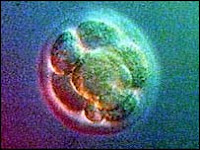
Hybrid embryo15:30 Breaking News: As expected, the Human Fertilisation and Embryology Authority has given the go-ahead for the creation of human-animal embryos for research. The Government's U-turn follows an HFEA consultation that apparently showed the public were "at ease" with the idea when told it could pave the way for therapies for conditions such as Alzheimer's disease.

Which rather begs the question, as well as being told about some of the theoretical possible benefits, were the public also told about the even more probable risks? For, contrary to the impression given by some of those who argue in favour of creating human-nonhuman cybrids (cytoplasmic hybrids), some of the most relevant questions relating to the ethical discussion arise not from a consideration of human dignity or any religious grounds but rather from a scientific perspective and the actual possible usefulness of these entities.

In this regard, a report by BioCentre, The New Inter-Species Future?, made the following points:

1. Experiment needs confirming

The scientific merit and validity of experiments already undertaken (involving cow-human and rabbit-human hybrid embryos) remain to be confirmed by an independent research group repeating the procedures.

2. Interspecies mitochondrial-nuclear DNA dysfunction

The medical risks of implanting cells that contain a combination of animal and human mitochondrial DNA and human nuclear DNA are considerable, given that there are varying degrees of interspecies incompatibility between mitochondrial and nuclear functions. Furthermore, it should be noted that mitochondrial dysfunction has been discovered to be a key factor in many neurodegenerative diseases such as Alzheimer's and Parkinson's diseases. Since many of the diseases claimed to be treatable by therapeutic cloning are neurodegenerative, using stem cells from human-nonhuman cybrids would be liable to result in profound medical risks. Similarly, the use of such stem cells to treat heart or liver complaints could create a number of difficulties owing to the high level of mitochondrial activity in these organs.

3. Difficulty in interpreting results

Regarding the use of human-nonhuman cybrids for research into diseases, there are so many profound genetic and epigenetic flaws in cloned embryos (even using eggs of the same species), that to use embryos created by interspecies nuclear transfer would be liable to become a study of artefacts. In other words, it would be difficult to interpret the results. The potential of an experiment, to add to the sum of knowledge is only as good as its capacity for interpretation.

4. Risk of creating new diseases

There would also be risks of transmission of animal diseases to humans or the creation of new diseases if any of the cybrid embryos were implanted into a host or not kept in a bio-secure environment.

5. Immunological incompatibility

Finally, it should be noted that it is doubtful whether the cells arising from human-nonhuman cybrids, in which an animal egg is used would become more human with development from the perspective of immunological compatibility and could ever have clinical applications. Because of this, and other factors, it is extremely unlikely that they would be used for transplantation in human patients.

24 July 2007

21st-Century Catastrophism

The Independent: A 21st century catastrophe

No one can yet attribute the flood events of the past week, or indeed, those of June, when Yorkshire suffered what Gloucestershire and Worcestershire are suffering now - again from one single day's rainfall - directly to global warming. All climates have a natural variability which includes exceptional occurrences.

But the catastrophic "extreme rainfall events" of the summer of 2007, on 24 June and 20 July, are entirely consistent with repeated predictions of what climate change will bring.
Excuse me? I don't think so! As the report in today's Independent goes on to make clear, current climate models predict that, although winters are predicted to be wetter, summers are supposed to be hotter and drier. As Michael Crichton correctly noted in his State of Fear, scientists' inability to make predictions over the past 5-20 years consistent with what has since happened underlies how little we understand trends and changes in the climate and invalidates any longer term predictions that are currently so fashionably bandied about.

It may well be that British summers will become wetter in the years that they are not hotter and drier, and that may well be caused by El Niño, La Niña, and cooler water in the Pacific Ocean off South America affecting the path of the Gulf Stream, but climate models to date have not predicted this — though no doubt it won't take the likes of Peter Stott at the Met Office's Hadley Centre for Climate Prediction and Research long to produce a new model "confirming" the newly postulated link between increases in rainfall and climate change. Whatever happened to rigorous scientific methodology...?

21 July 2007

State of Fear

Michael Crichton: State of FearWhile everyone else is reading the final installment in JK Rowling's very profitable Harry Potter phenomenon, I've spent the day racing my way through a book that a friend recommended to me last weekend: Michael Crichton's environmental adventure, State of Fear.

Rather predictable, it nevertheless made for an entertaining few hours. The author clearly intends to open the eyes of anyone of the opinion that "Everyone believes in Anthropogenic Global Warming!" However, my guess is that few people are going to become scientifically informed or challenged by a thriller, and even fewer take the effort to investigate the many source references that he provides.

Crichton attempts to summarise his assessment of current beliefs in his speech, Environmentalism as Religion. Yet, for all his attempts at persuasion, it's far easier to accept the dismissal from groups such as the Natural Resources Defense Council (who are "the earth's best defense" — or so they claim!) than to risk being branded a heretic. After all, nobody likes to be the object of a witch-hunt (except certain Hogwarts fans, I suppose). And these days, even some churches and Christian organisations are treating AGW sceptics as "wounded" (to borrow the Pope's recent description of non-Catholic Churches). Which is rather ironic for, as another friend recently put it to me, "Given that the Bible clearly states that the whole of creation is to be destroyed, what are Christians doing jumping on the bandwagon to save the planet when their commission is to save souls?"

On one point at least we can surely all agree that Crichton is right: "Perceiving the truth has always been a challenge to mankind, but in the information age (or as I think of it, the disinformation age) it takes on a special urgency and importance." When it comes to environmentalism, as with all matters political, scientific, and religious, we need open and informed debate.

19 June 2007

Undignifying Research?

Genetic research on human-animal chimerasThe Independent reports that Britain's top scientists are calling on the Government to lift a ban on the use of embryos created from human eggs and animal sperm.

In actual fact, the Academy of Medical Sciences report, Inter-species embryos, does not go as far as making any such explicit call. It simply notes, "The reasons for banning the creation of hybrid embryos for in vitro experimental use, while permitting research involving other types of human embryo incorporating animal material, are not clear to us, but we are not aware of any current scientific reasons to create such entities," adding elsewhere, "However, given the speed of this field of research, the emergence of scientifically valid reasons in the future cannot be ruled out."

Somewhat ironically, though, in making their case for proceeding with research on other kinds of hybrid and chimeric embryos, they use an argument that could equally undermine respect afforded to people who are disabled or elderly. For they argue that human "dignity arises from the qualities possessed by a creature, rather than species membership per se." Explaining their point in more detail, they state:

"We judge it unlikely that ‘human dignity’, a phrase used to emphasise the special moral status and importance of human beings, derives simply from species membership. If the concept of ‘human dignity’ has content, it is because there are factors of form, function or behaviour that confer such dignity or command respect. Either hybrid creatures would also possess these factors or they would not. If they do possess these factors, they would also have a specific type of dignity analogous or identical to human dignity that other creatures lack; if not, they would not."
However, they do not define what these mystic "factors of form, function or behaviour" are. If we can justify excluding human rights from individuals who because of their immaturity lack certain undefined "factors of form, function or behaviour," then what is to prevent us from excluding those same rights from individuals who because of physical or mental impairment also lack those same factors?

Conversely, if human rights are rightly extended to the physically disabled, the mentally impaired, and individuals in a persistent vegetative state, and if "human" rights are even to be extended to great apes and robots, on the basis of "the qualities possessed by a creature" though they do not even share "species membership" with us, then how can we justify excluding those same rights from individuals who because of their immaturity lack certain undefined "factors of form, function or behaviour"? Or, to encroach on the abortion debate, at what point of maturity do embryos acquire the necessary "factors of form, function or behaviour" to merit their protection from needless destruction? At present, the creation and use of human embryos for research is not permitted beyond 14 days in vitro. In order to be consistent, should the time frame allowed for human embryo research be extended to 24 weeks to match that for abortions, should the time frame for abortions be reduced to 14 days to match that for in vitro experiments, or should some other compromise be reached?

15 June 2007

Ethical Science

It's not every day that I agree with something Peter Mandelson, the EU Trade Commissioner, says. So, his defence of what he calls "The coal face of applied science in the twenty first century," biotechnology, is worth quoting from quite extensively:

"We need an open and rational debate about the risks and benefits of biotechnology more than ever."

"We are already living in a biotech era – from the medicine you take to the laundry detergent you use. ... The most recent Eurobarometer on this subject from 2005 actually showed that most Europeans are enthusiastic about potential new applications of biotechnology. But there is one glaring exception. Something like six in ten Europeans say they oppose Genetically Modified food."

"It is reasonable to insist that when the process [of thoroughly testing all new biotech products to the most rigorous scientific standards] has run its course, and the scientific issues have been thrashed out, we stand by the science. And that applies to both the technical experts and to the politicians they report to. A rigorous system means approving GM imports when the science is on their side just as we take a firm line when precaution is justified. ... If politicians and risk managers undermine their own system... we devalue objective science as our most important benchmark - and that is a dangerous step to take."

"We must be under no illusion that Europe's interests are served by being outside a global market that is steadily working its way through the issues raised by GM food. They are not."

"The biotech industry needs to keep in mind that while technology determines what is possible, consumer demand determines what is economically viable. Public fears may be misplaced, but they cannot and should not be dismissed."

"The way that human technologies affect us and the natural world has always been a flashpoint for debate. Biotechnology is no different. The only rational response is a patient assessment of the evidence and a careful explanation of the facts. Biotechnology has already improved millions of lives around the world. That alone is reason enough to ensure that we do not deny those benefits to millions more."
The only point that I would add is he makes no mention of ethics. If the public believe there are ethical questions to answer, even if the scientists and politicians do not, then the "open and rational debate" and "careful explanation of the facts" needs to address those fears also.

24 May 2007

More Global Warming Evidence

polar bears on the edge of the ice packAnyone who has watched or listened to the BBC's news lately will know they have become rather absorbed by an event that happened two years ago, when a sizeable chunk of the Arctic ice sheet came loose, setting it on the same course as all other icebergs.

You can be reasonably sure that they will not be giving the same airspace to the latest scientific evidence on global warming. For, a new study into Atlantic hurricanes published in Nature has found little correlation with ocean temperatures. Just as with recent research on hurricane activity in the Atlantic, Kilimanjaro's melting glaciers, rising sea levels, and changes in polar bear populations, the hard facts conflict with the fashionable message being promoted by the climate change industry.

The research, which analysed sediment records going back 5000 years, instead discovered an inverse correlation with El Niño-related warming in the eastern Pacific. So, whenever El Niño picked up in the Pacific, then hurricanes were almost non-existent in the Atlantic. Conversely, whenever El Niño fell away, the storms kicked up again. In the words of one of the researchers, we need to "Consider the whole picture: On the centennial and millennial scale, El Niño seems to trump the warming processes in the Atlantic."

03 May 2007

Super Thursday

Noticed this on the BBC:

School science changes 'rushed'

experiment using Bunsen flame The move to a more flexible school curriculum in England is being rushed, leading science organisations claim.
Learned societies, teachers and others say it is alarming that changes for 11 to 14-year-olds are not being piloted.

Schools are under too much pressure from other developments to implement the changes in 2008 successfully, the group argues. They should be postponed.
Anybody else see any other controversial news that might "disappear" in the rush of election news today?