St George's Cross Offensive
![Inter’s centenary shirt [Credit: Goal.com]](https://lh3.googleusercontent.com/blogger_img_proxy/AEn0k_skPZrsEZ6LWWO5RqrYH882ZWKc8n4IiB7GocsBBQWlA96DOS2Rze4HM4Nbfmcgw48kYZ-svJ8bg0NxIFcn3ULU7Owt7TsFu27cr74=s0-d)
Oh, please! Whatever next... After Turkey is allowed to join the European Union, is England to redesign Saint George's Cross?!

Oh, please! Whatever next... After Turkey is allowed to join the European Union, is England to redesign Saint George's Cross?!
What a week we're having! Kevin Rudd sweeps to power as prime minister with a landslide victory over John Howard in Australia. Palestinian President Mahmoud Abbas and Israeli Prime Minister Ehud Olmert agree to resume long-stalled peace talks. President Pervez Musharraf steps down as Pakistan's chief of army staff and Turkish President Abdullah Gul accepts his invitation to hold talks next month in Pakistan. All these geo-political developments taking place against the domestic backdrop of Labour's latest funding scandal and the transfiguration of Brown from "a safe pair of hands" to slippery fingers, from "great clunking fist" to over-rated flunking fiddler — or, as the LibDem's acting leader Vince Cable so memorably put it in today's PMQs, from Stalin to Mr Bean, "creating chaos out of order rather than order out of chaos."
Whatever next? Keep your eyes on Russia, China and Iran...
 What's the difference between human rights abuses in China and human rights abuses in Turkey? On one the US is willing to ignore threats from its counterpart, bestowing the Congressional Gold Medal, its highest civilian honour on the exiled Tibetan spiritual leader, the Dalai Lama today. On the other the US is backing off from legislation approved last week by a congressional panel to call a vote on a measure declaring the World War I-era killings of Armenians by Ottoman Turks an act of genocide.
The proximity of Turkey to the ongoing conflict in Iraq might explain the apparent inconsistency...
 Foreign Minister Abdullah Gul was a member of the Islamist Welfare Party cabinet ousted by the Turkish army ten years ago for being too Islamist. Today, despite recent protests, the country's ruling AK Party has announced that it supports his renewed bid to become Turkey's next president.
You may wish to comment on the following, which I received from one of our correspondents in Turkey:
What the great Kemal Ataturk established in 1923 was a country that held all people in high esteem regardless of race or religion, hence the popular saying "insan insan olsun" — let all people be people. If we are to understand the events of today in Turkey we need to view them in their historical setting — something I think the foreign office in more than one country fails to do when considering this part of the world.
The Republic of Turkey and its constitution were born of the Ottoman Empire. This is a source of pride, but nobody would want to return to the days of a "Universal Empire" any more than those who take pride in "Great Britain" would want to go back to colonialism. Instead we want to build relationships with other countries for mutual benefit and work together to live in a better world. To quote Ataturk, "Peace at home, peace in the world."
What threat do Abdullah Gul and Tayyip Erdogan make toward this very normal and modern thinking? They were welcomed into office and many people were delighted at their appointment as Prime Ministers. There was no threat to the secular constitution as long as President Sezer was in office and overseeing the all important Army - the defenders of the secular constitution. That guarantee is now under threat and that is what the people are disturbed about. Many members of this political party are linked to other parties that used to promote an Islamic state in Turkey. It is feared that they could rewrite the precious constitution in favour of an Islamic constitution. Yesterday Iran, tomorrow Turkey?
Would they do it? Looking at the history of the prime minister, who was photographed with known terrorists, and with so many of the party historically associated with a pro-Islamic constitution, one can understand the concern of the people. We will hear statements from the EU and the USA about democracy and human rights. Yet these democracies have a history of supporting the likes of Osama bin Laden and Saddam Hussein in the name of promoting democracy, so I hope they will think a little longer before expressing their opinions about Turkey and consider more deeply the issues that these great people are working through.
For further analysis, see CNN: The man splitting Turkish society
![Protestor with sign reading, 'Erdogan is another Saddam. Turkey, hands off Kurdistan. Free Kurdistan' [Credit: Leyla Zana]](https://blogger.googleusercontent.com/img/b/R29vZ2xl/AVvXsEjBD33OvbWlVxL_hRS9bxw0bjsPhBwhc6M5vaIPllkk19SLZEIKt8m5-buEHMZ2VdzA8n1AmYziOtO6czjKjoue4K2O45q88W0FkiXnDWWDJcRZmxtU8zGEQA5EmzgyEzBgql-ohspGCgYw/s400/Erdogan.jpg) A Turkish invasion would, according to the IHT, "infuriate Arabs, who would resent any Turkish return to areas once ruled by the Ottoman Empire. It would finish off any remaining hope of Turkey joining the European Union. And it would put a huge strain on Turkey's fragile democratic politics. In short, it would be a disaster."
A Turkish invasion would, according to the IHT, "infuriate Arabs, who would resent any Turkish return to areas once ruled by the Ottoman Empire. It would finish off any remaining hope of Turkey joining the European Union. And it would put a huge strain on Turkey's fragile democratic politics. In short, it would be a disaster."
So, why is a huge military build-up already under way on the Turkish side of the border and why has Ankara been issuing a flurry of angry charges that the Iraqi Kurds are providing sanctuary to murderous anti-Turkish guerrillas? Quite simply, because should Iraq finally achieve a peaceful status in our lifetimes, it will probably involve a tripartite federal state and, with a Kurdish state on its borders, Turkey's 15 million-strong Kurdish minority may be emboldened to demand autonomy or independence. However, any pre-emptive Turkish incursion into Iraq now would pose a serious threat to the already unstable balance that America is holding in Iraq, so it is unlikely they are going to stand idly by and watch their already fragile work undone.
Media coverage may not currently make the Turkish-Kurdish conflict seem as live an issue as the hopes of Israelis and Palestinians, but the reality is that any peace deal in the Middle East is going to need to accommodate all those who have nursed historic grievances—which means that those who are negotiating peace deals and introducing democracy to the region need to possess a rounded understanding of history and involve all parties.
"The international community must put more pressure on [Uzbek President Islam] Karimov or there will be another Andijan."![Today's anti-government rally in Izmir [Credit: insurancebroadcasting.com]](https://lh3.googleusercontent.com/blogger_img_proxy/AEn0k_tBjLsaJZg89mzJQt2W4cW5wEYVLDOoa8SIFoo16KhTCT5peXgDpDmO7q3lSeh9P6h9lftk8t3GPkK3kb9eQywxCA-RQD_2-MMMohkMR5rma_aen6ax=s0-d)
This blog has monitored developments in Turkey as what happens there has the potential for having significant implications for both the direction of the European Union and the global conflict between moderate and extremist Islam. If we are serious about our desire to help promote democracy, then current human rights abuses in Uzbekistan should be of equal concern to us, as the country is of strategic importance to the future of the whole region.
When I worked in Central Asia, I often heard it said of the fertile Ferghana Valley in the east of Uzbekistan, the most populated area in Central Asia, that "Whoever wins the hearts of the people of Ferghana will win the hearts of the Uzbeks — and whoever wins the hearts of the Uzbeks, will win the hearts of the whole of Central Asia." The West was wrong in 2005 to let Karimov play the disingenuous "war on terror" card and claim he was quashing Islamic extremists, just as the Foreign Office was wrong to censor the British ambassador to Uzbekistan Craig Murray when he attempted to raise concerns about widespread torture in the country.
If our Government's promises about developing a foreign policy with an ethical dimension are to mean anything, then we cannot continue overlooking such abuses. As we ponder what a truly ethical foreign policy would look like, it might be helpful to take a couple of minutes and watch this BBC news report recalling the Andijan uprising. We should be as determined that the blood of the hundreds of civilians killed there two years ago eventually leads to freedom in their nation as we are about the sacrifices still being paid daily in Iraq and Afghanistan.
Breaking News: Turkey's parliament has just approved by 361 votes to 94 a first reading of the constitutional amendment proposed by Prime Minister Recep Tayyip Erdogan last Sunday to allow the country's president to be elected directly by the public instead of by MPs. The proposal will now need to be debated and approved a second time before President Ahmet Necdet Sezer signs it into law — assuming the courts don't block its passage.
In view of the risks for Europe if Turkish reformers are rebuffed, it is hoped both that these tentative moves towards greater democracy will prove successful and that the commitment from France's new president-elect to "be on the side of the oppressed around the world" and his conciliatory talk of a "Mediterranean Union" between Europe and Africa will mean Nicolas Sarkozy, whose five year mandate will be over before any decision is made on Turkey's bid to join the EU, will adopt a softer line on Turkey once he is in office than he did during his campaigning.
Breaking News: Following more protests in Turkey yesterday, the Islamist Foreign Minister Abdullah Gul has failed to attract sufficient support in today's parliamentary vote to nominate a new president and is now withdrawing from the race. Although it is uncertain who will be chosen, I expect this will bring some relief and cause some celebration throughout the country - and, indeed, across Europe.
![Pro-democracy protesters at Sunday's Istanbul rally [Credit: Reuters]](https://lh3.googleusercontent.com/blogger_img_proxy/AEn0k_vqJMWGFuTKfSf7KqX-5l2pjev-RAc1hGKAwr5a81WDpe2cPtRjBEuj5iGE6WMpVlzy_3gy7hs16hiVziQpq5ncHRyFYn3ak-avkqapeejDnBSGyVY7XyWIGVJaT309Igzvrt8BYf93tkU=s0-d)
The Islamist-rooted government may now call early general elections in an attempt to diffuse the crisis, possibly as soon as the middle of next month. However, elections are unlikely to make a significant difference as the various secular parties on the left and the center-right lack charismatic leaders and are unable to work together. Although Turkey has twice previously had a prime minister from an Islamic party, the president is expected to maintain the country's secular system, founded by Ataturk in 1923, and is responsible for appointing the prime minister, the military's chief of staff, and members of the Constitutional Court. Whatever happens, Turkey looks set for a period of uncertainty and instability in the weeks and months ahead.
Evening UPDATE: Prime Minister Recep Tayyip Erdogan has announced that he will tomorrow apply to parliament to hold the general election on June 24 or July 1. More significantly, he will also propose a change in the constitution to allow the country's citizens to elect the new president, instead of the present system in which parliament chooses the president. If this actually happens, it would represent a genuine shift towards open democracy – we live in interesting times.
Thursday UPDATE: The Turkish Parliament has unanimously approved early elections for July 22, despite concerns that many Turks will be away on holiday at that time and therefore unable to vote.
![Istanbul Rally [Screenshot from BBC News]](https://blogger.googleusercontent.com/img/b/R29vZ2xl/AVvXsEiY-i2VF8sur0_zqwrTou6JLiudshphXDmapCtUyor6Ihj8c1W2tgqE7IrAwHN42DIUkB_wT0y3P0ieAuv-72m8kHdSZsfINgAJXIG8pr9wzmxwp2nCctVvq35zCkZ5g_iwFXbTzO6Iympr/s320/turkeyrally.JPG) This blog has raised various concerns about events in Turkey and the apparent threat to the country's modern, secular foundations. It is to be hoped, therefore, that the voices of the 1,000,000 people who took part in today's rally in Istanbul plus the 300,000 in Ankara a fortnight ago will prevail.
This blog has raised various concerns about events in Turkey and the apparent threat to the country's modern, secular foundations. It is to be hoped, therefore, that the voices of the 1,000,000 people who took part in today's rally in Istanbul plus the 300,000 in Ankara a fortnight ago will prevail.
The protesters are calling for the government's resignation over the Islamist roots of the ruling Justice and Development Party (AKP) and its presidential candidate, the present Foreign Minister Abdullah Gul. Crucially, the protesters enjoy the support of the military, which is one of Turkey's most respected institutions and has led three direct coups against elected governments in the last half-century (in 1960, 1971 and 1980, also helping to engineer the "post-modern coup" of 1997 against the then Islamic-oriented government).
If any of our readers in Turkey could provide additional insight or a personal perspective, please do leave a comment or else email me.
Don't just take my word for it – read this from today's International Herald Tribune, coming just days after Turkish armed forces began "a spring offensive against rebels with the PKK" (Kurdistan Workers Party):
It is important to understand the dynamic effect the European Union has had on the Turkish political system. The very prospect of Turkey's EU membership has been nothing less than an anchor of economic and political reform.
The overwhelming popularity of the EU project among average Turks in 2003-2004 made it possible for Erdogan's government to undertake a series of far-reaching political changes. The overall affect of these reforms was the development of a more open and democratic Turkey and a much diminished capacity for the military to meddle in politics. Indeed, by the end of 2004 when the EU commission recommended that membership negotiations with Ankara begin the following calendar year, Turkey was firmly on a liberal, democratic trajectory.
Just as the European Union was decisive in spurring Turkish reform a few years ago, Brussels is currently contributing to a return of some old and bad habits in Ankara. ...
The consequence of European opposition to Turkey's accession is a precipitous decline in support for Union membership among Turks. In 2004, some 77 percent of Turkey's population favored taking the necessary steps to join Europe, now only 30 percent do so. Candidate countries often exhibit a drop in public enthusiasm for EU membership when their populations confront the reality of both abdicating some sovereignty to Brussels and the hard task of conforming to the Union's laws, decrees, and norms. The fact that Europe's opposition to Turkish membership is based on religious and cultural factors only accentuates this problem.
In Turkey, the negative signals from Europe and subsequent steep fall off in support for EU membership have provided the generals with room to maneuver in the political arena.
It has been brought to my attention [thanks Iain!] that Peter Hitchens has written an insightful article about his recent travels in Iran and a friend has suggested that I repeat here a small piece that I wrote after I visited Iran together with my wife and children ahead of the 2005 Presidential elections. For those of you who don't know and by way of background to some of the references below, I worked in the Persian-speaking world for a number of years and have always found the hospitality-based culture throughout Central Asia to be extremely welcoming.
 We found Iranians to be extremely open, significantly more so even than elsewhere in Central Asia, constantly welcoming us as they passed in the street and stopping to talk – our favourite greeting was the cyclist who yelled the above quote at us as he raced past us.
We saw all the signs of a free and vibrant political process in the run up to the country’s presidential elections and, contrary to Western media portrayal, saw no evidence of anti-Americanism. Rather, we found a desire for improved international relations. Only one religious leader we spoke to in an Islamic school appeared somewhat perplexed by us – but that could have been because he hadn’t met Westerners fluent in his language before, because he hadn’t had an American woman in his school before, or because these two children had what he thought of as Muslim names but were apparently Christian. If he had seen how my son was moved to pray for the people of Iran in the Royal Mosque in Isfahan, he would no doubt have been even more baffled!
Another notable and unexpected observation was the comparatively unobtrusive influence of Islam. Whereas Turkey claims to be secular but every skyline is defined by its towering minarets and the call to prayer is inescapable, mosques in Iran were generally far more secluded and in the week of our visit we only heard the call to prayer four or five times. Yes, every woman has to cover her head completely, yet the boundaries of even this dress code are being progressively tested, especially among the young (who make up the majority of the population), with headscarves being worn further back across the top of the head with each passing year and repeatedly being allowed to slip and re-adjusted when in the workplace. One 26-year-old devout Muslim with whom I had a long religious and political conversation on one of our flights observed that most people are increasingly disillusioned with Islam because it promises "power and wealth in this life and the next" but the religious leaders failed to deliver on this promise after they assumed political leadership in the country. The demand for change is widely expected to increase in the wake of the elections.
Hopefully the above account will help explain some of my other posts about Iran that may have baffled some of you – and perhaps also some of those about Turkey.
A German and two Turkish employees of a publishing house that distributes Bibles in eastern central Turkey have had their throats slashed, their hands and feet first being bound and their mouths gagged, despite being police protection.
The attack took place in the city of Malatya, a known stronghold of nationalists about 500 miles southeast of Istanbul and the hometown of Mehmet Ali Agca, who attempted to assassinate the late Pope John Paul II in 1981. The police arrived in time to see one of the assailants jumping from a second floor window and detained a total of five suspects at the scene. A Turkish television station has claimed the youths were all carrying an identical note declaring, "We did this for our country. They are attacking our religion."
It is believed the attack was the work of a local Islamist militant group and police are investigating the possible involvement of Turkish Hizbollah, the Kurdish Islamic group that aims to form a Muslim state in the Kurdish-dominated south-east.
Once again, how the Turkish authorities deal with this case will reveal much about the country's commiment to religious freedom. It is just over a year since Father Andrea Santoro was murdered while praying in his church in Trabzon, also in the east of the country, and exactly three months since the journalist and former chairman in the Armenian Evangelical Church, Hrant Dink, was assassinated in Istanbul.
Following Turkey's objection's to the UN's genocide exhibit, you might be interested to learn that the Council of Europe, ever sensitive to such delicate matters, is launching its inaugural human rights film award, FACE, this weekend at the 26th International Istanbul Film Festival.
Each of the ten films shortlisted for the prize deals with themes of political liberty and individual freedoms:
"Following World War One, during which one million Armenians were murdered in Turkey, Polish lawyer Raphael Lemkin urged the League of Nations to recognize crimes of barbarity as international crimes."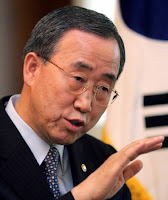 A United Nations exhibit that was supposed to be opened by U.N. Secretary-General Ban Ki-moon yesterday has been delayed following Turkish objections to the inclusion of the above sentence. Speaking on the thirteenth anniversary of the Rwanda genocide in which 800,000 Rwandans were slaughtered in an orchestrated campaign, Mr Ban called for a "global partnership against genocide" and made the U.N. special adviser for the prevention of genocide a full-time post.
Meanwhile, evidently more comfortable arguing over history than taking concerted action on the subject, the international body is still waiting for approval from the Sudanese government to send in U.N. troops to Darfur.
EXCLUSIVE: My sources in Turkey inform me that authorities in the north-west of the country are trying to shut down yet another local church, less than a month after it purchased a building to use as its place of worship. The church is also being falsely accused in the local press and on local television of offering $25,000 to people who are willing to change their religion.
Property ownership for minority religious communities is beset with problems. Groups such as the Greek Orthodox, Armenians, Syrian Orthodox, and Jews are supposed to be allowed to own their own places of worship, while for Catholics and Protestants, the congregations or church communities have to own the buildings. Yet the state often refuses to recognise even this.
When negotiations were still in progress over Turkey's possible accession to the European Union, the country appeared willing to make concessions over religious freedom. However, now that these have stalled over the Turkish government's refusal to recognise the government of Cyprus in Nicosia, it seems that neither the governing Islamist-based Justice and Development Party (AKP) nor the opposition Republican People's Party (CHP) accepts the principle that all their citizens have rights. Neither party appears to have read or understood Article 9 of the European Convention on Human Rights, still less that they are ready to grant individuals their rights to religious freedom. Turkish diplomats and secularist government officials fear that if the AKP increases its vote in elections scheduled later this year, it would be strong enough to change the Constitution; also that it could install a President who, unlike the current President, would not veto laws deemed to be part of an Islamist agenda.
It is just over a year since Father Andrea Santoro was murdered while praying in his church in Trabzon, in the east of the country, and less than two months since the journalist and former chairman in the Armenian Evangelical Church, Hrant Dink, was assassinated in Istanbul.


